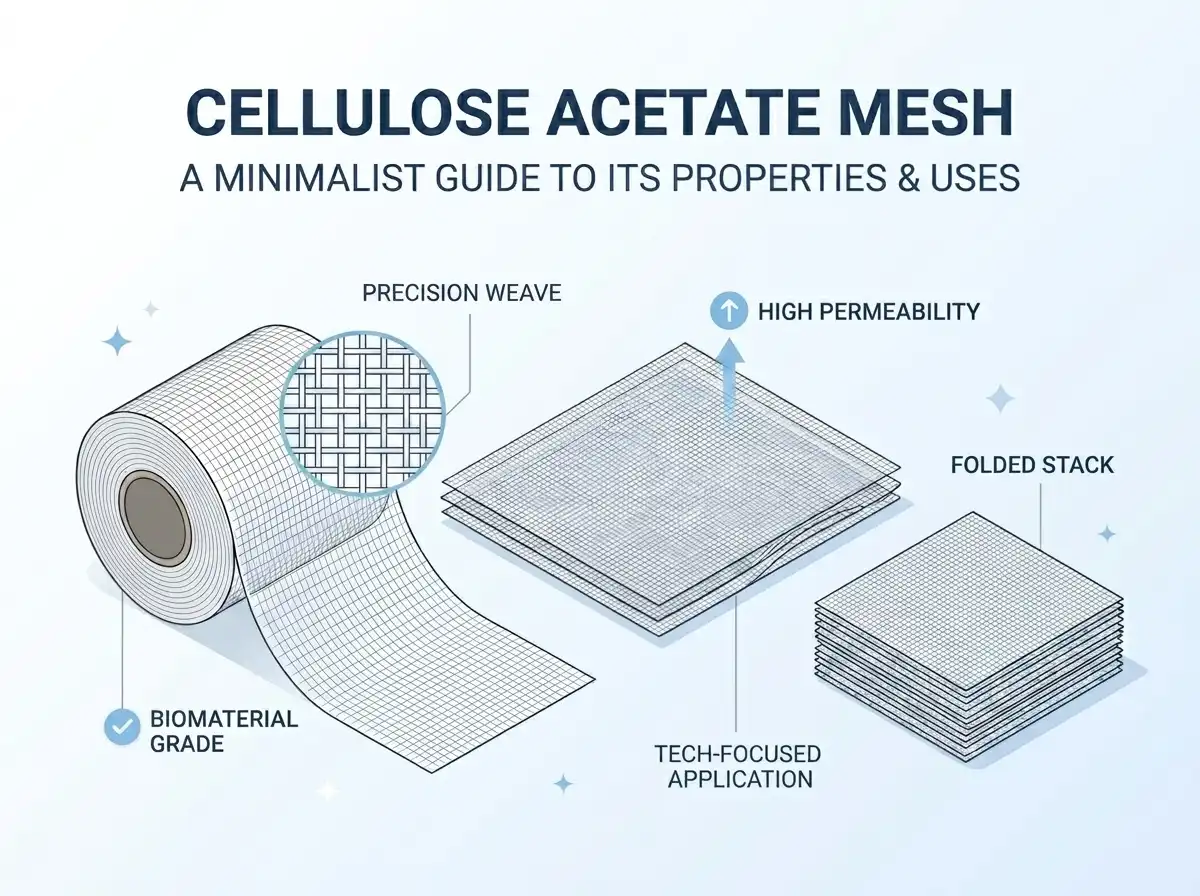
Cellulose Acetate Medical Fabric is a soft, skin-friendly medical textile designed for wound care and protective applications.
Our new product, Cellulose Acetate Mesh, is a knitted mesh fabric designed for wound contact layer applications. As a medical fabric material, it:
- Does not adhere to the wound bed
- Allows exudate to pass through easily
- Feels soft and gentle on sensitive or burned skin
Most traditional dressings stick to the wound and tear new tissue when removed. This material is specifically engineered to prevent that.
This guide covers:
- What Cellulose Acetate Medical Fabric is
- Where it works best
- The real benefits — with clinical data
- What B2B buyers should check before ordering
Let’s start.
What Is Cellulose Acetate Medical Fabric (and Cellulose Acetate Mesh)?
Cellulose Acetate = Biocompatible, Not Just “Another Fabric”
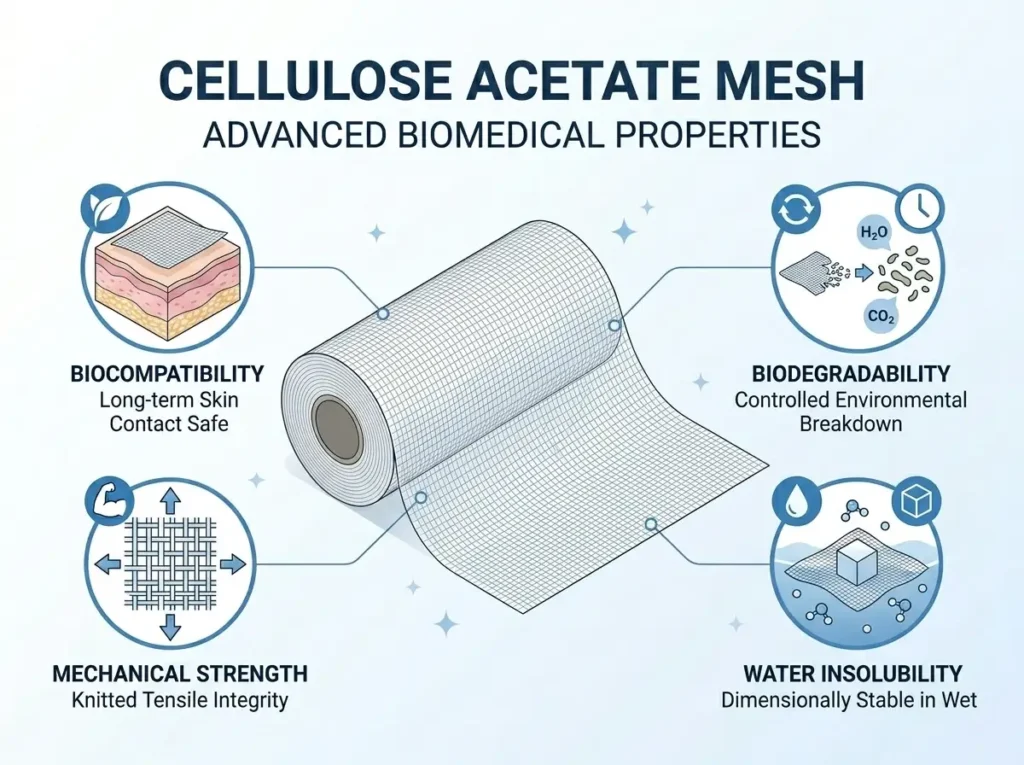
Cellulose acetate is a polymer made from cellulose. In medical use, it’s valued for:
- Biocompatibility – safe for long-term skin contact
- Biodegradability – breaks down after use
- Water insolubility – stays stable in wet conditions
- Good mechanical strength – can be knitted into mesh, fibers, or films
It’s used in wound dressings, antimicrobial membranes, dialysis membranes, and drug delivery systems.
At Haody Medical, we use cellulose acetate to make medical fabrics that are soft, breathable, and gentle on skin. Our Cellulose Acetate Mesh is a knitted mesh fabric optimized for use as wound contact layer material — the same type of knitted cellulose acetate structure widely used as the base fabric in professional wound care products worldwide.
How It Differs from Other Medical Fabrics
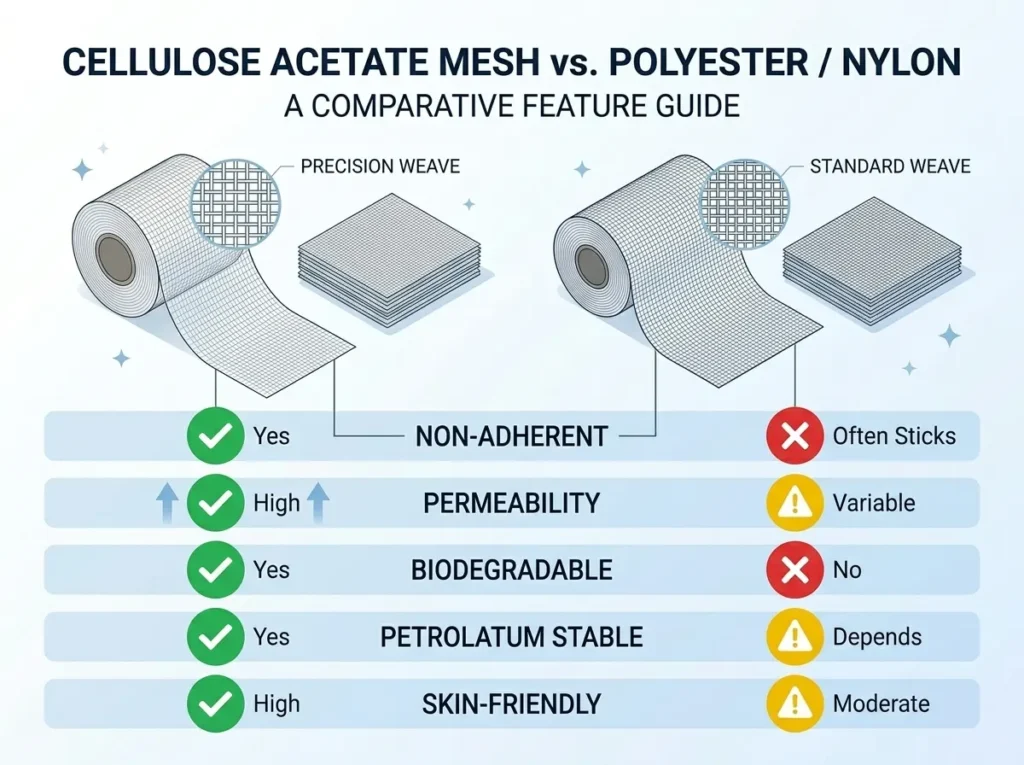
Here’s a quick comparison:
| Feature | Cellulose Acetate Mesh | Polyester / Nylon |
|---|---|---|
| Non-adherent | ✅ Yes | ❌ Often sticks |
| Permeability | ✅ High | ⚠️ Variable |
| Biodegradable | ✅ Yes | ❌ No |
| Petrolatum stable | ✅ Yes | ⚠️ Depends |
| Skin-friendly | ✅ High | ⚠️ Moderate |
5 core features of this medical fabric:
- Non-adherent to wound bed – prevents granulation tearing during dressing change
- Good permeability – exudate passes through to absorbent back layer, maintains moist healing environment
- Soft, skin-friendly & low irritation – ideal for sensitive and burn skin
- Chemically stable with petrolatum – no swelling or damage from vaseline coating
- Biodegradable – eco-friendly disposal after use
3 unique advantages of Haody Medical’s version (not covered by most competitors):
- Consistent pore size and mesh density – uniform mesh structure across batches improves exudate management consistency
- Customizable surface treatments – antimicrobial coatings, hydrophilic treatments, or other modifications available for OEM/ODM
- Vertical production control – we manage raw material → knitting → final product under one roof, ensuring quality and faster customization response
Where Cellulose Acetate Mesh Works Best
1. Primary Wound Contact Layer Applications
As a medical fabric material, Cellulose Acetate Mesh is well-suited for use in primary wound contact layer applications. Clinical evidence on knitted cellulose acetate mesh fabric shows it:
- Reduces tissue ingrowth risk when used in wound contact layers
- Minimizes trauma during dressing removal
- Works across dry to highly exuding wound applications
Suitable for product development targeting:
- First and second degree burns
- Lacerations and abrasions
- Grafts
- Venous ulcers and pressure ulcers
- Nail extractions, eczema, staples, suture lines
- Surgical incisions and reconstructive procedures
2. Burn Care and Sensitive Skin
For burn care products, patient comfort is critical. Our fabric is:
- Soft and skin-friendly – reduces discomfort and allergy risk
- Low irritation – suitable for fragile, sensitive skin
- Safe for long-term contact with burned or sensitive areas
These properties make it a strong material choice for burn care product development and sensitive skin applications.
3. Secondary Dressing Layers and Protective Textiles
Beyond primary wound contact, this medical fabric material can also be incorporated into:
- Secondary dressing layers – supporting exudate management
- Protective textile inner layers – for medical garments or protective apparel
Because it’s chemically stable with petrolatum, it can be combined with petrolatum-based formulations without swelling or structural damage. Its biodegradable nature also supports sustainability-focused product design.
The Real Benefits (With Clinical Data)
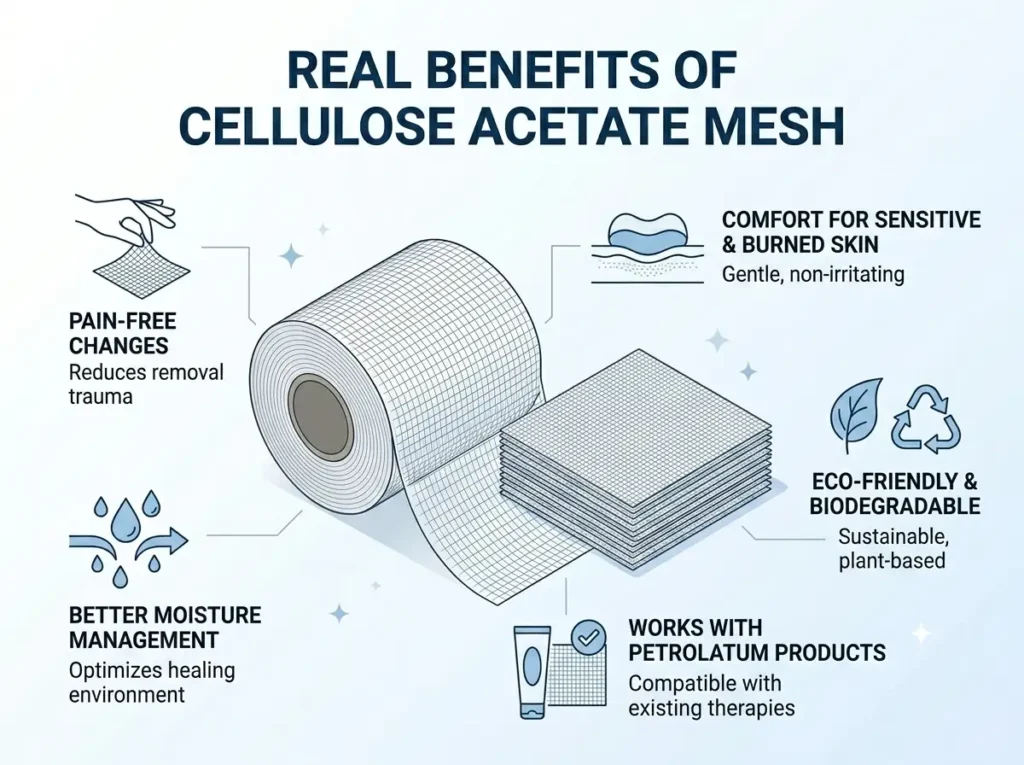
Benefit 1: Pain-Free Dressing Changes
Traditional dressings stick → pain + tissue damage.
As a wound contact layer material, this fabric:
- Does not adhere to the wound bed
- Prevents granulation tearing during changes
- Reduces patient pain and discomfort
- Enables nurses to work faster and more gently
Clinical data on wound dressings made with knitted cellulose acetate mesh fabric shows 75% of patients experienced pain-free removal, compared to 56% and 51% for other commonly used non-adherent dressing materials.
This highlights the performance potential of cellulose acetate mesh as a wound contact layer material — especially for chronic wounds, burn care, and applications requiring frequent dressing changes.
Benefit 2: Better Moisture Management
Good moisture management supports faster healing.
The mesh structure:
- Lets exudate pass through to the absorbent back layer
- Reduces pooling and maceration risk at the wound site
- Maintains a moist healing environment
Result: Less exudate buildup, fewer dressing changes, more comfortable recovery.
Benefit 3: Comfort for Sensitive and Burned Skin
For patients with sensitive or burned skin:
- Soft – no rough or abrasive texture
- Low irritation – reduces allergy and reaction risk
- Safe for long-term contact with fragile skin
This makes it a critical material choice for burn dressings, post-surgical layers, and extended-wear protective textiles.
Benefit 4: Works with Petrolatum Products
Many wound care products use petrolatum (vaseline) for protection and comfort.
Our Cellulose Acetate Mesh:
- Is stable with petrolatum emulsion
- Shows no swelling or damage when coated with vaseline
This gives product developers full flexibility for OEM/ODM composite dressing design.
Benefit 5: Eco-Friendly and Biodegradable
Sustainability is a growing priority in medical procurement.
This material:
- Is biodegradable
- Supports eco-friendly disposal after use
- Provides a meaningful advantage over non-biodegradable synthetic alternatives
Material Comparison: Cellulose Acetate Mesh vs Alternatives
vs Polyester Medical Fabric
| Aspect | Cellulose Acetate Mesh | Polyester |
|---|---|---|
| Skin-friendliness | High | Moderate |
| Permeability | High | Variable |
| Biodegradability | Yes | No |
| Petrolatum stable | Yes | Depends |
| Best for | Sensitive/burn skin, wound contact layers | General durability |
Polyester is tougher and often cheaper, but cellulose acetate mesh wins on comfort and sustainability for wound care fabric applications.
vs Nylon and Other Synthetic Meshes
Compared to nylon:
- Softer and more skin-friendly
- Lower irritation for sensitive and burn skin
- Biodegradable (nylon is not)
- Stable with petrolatum coatings
For applications requiring direct, prolonged skin contact, cellulose acetate is the stronger material choice.
When to Choose This Material
Choose Cellulose Acetate Mesh when:
- ✅ You need a wound contact layer fabric
- ✅ Non-adherent behavior is critical
- ✅ Exudate permeability matters
- ✅ End users have sensitive or burned skin
- ✅ Your product line emphasizes biodegradability
- ✅ You want to combine with petrolatum-based formulations
What B2B Buyers Should Check Before Ordering
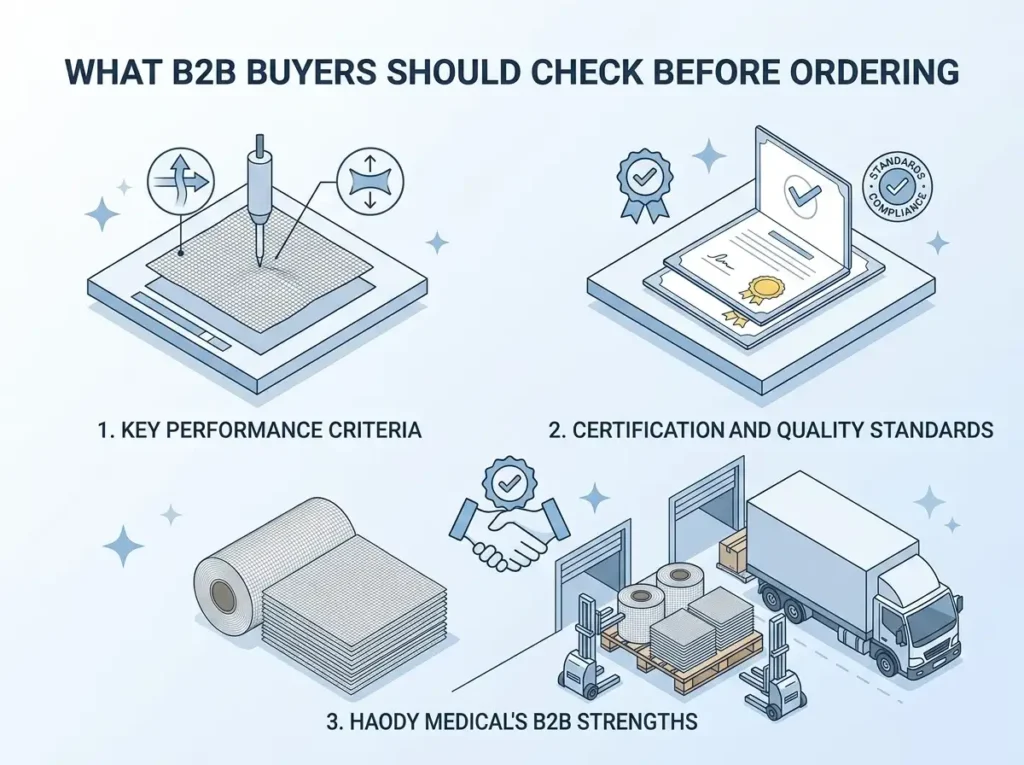
1. Key Performance Criteria
Before ordering any wound care medical fabric, check these 5 points:
- Non-adherent – does it stick to the wound bed?
- Permeability – can exudate pass through effectively?
- Softness and irritation – is it truly skin-friendly?
- Chemical stability – does it stay stable with petrolatum or other coatings?
- Biodegradability – is disposal eco-friendly?
Cellulose Acetate Mesh meets all 5 criteria.
2. Certification and Quality Standards
As a medical fabric material, it must be produced under proper quality management.
At Haody Medical:
- ISO 13485 certified quality management system
- 2,000+ tons/year medical product production capacity
- Branches: Anhui De da Kang Mei Medical Products Co., Ltd and Suzhou Delife Healthcare Co., Ltd
- Established since 2008 in Suzhou, Jiangsu Province, China
3. Haody Medical’s B2B Strengths
Here’s what sets us apart from other fabric suppliers:
- Vertical production – raw material → knitting → final product under one roof
- Flexible MOQ – small trial orders and large-scale production both supported
- Full customization – thickness, density, dimensions, surface treatments (antimicrobial, hydrophilic), and petrolatum combo options
- Proven track record – products trusted by major distributors including Cardinal Health and Medline in the US and Europe
Why Cellulose Acetate Medical Fabric Is Worth Considering
It balances three things most wound care fabrics struggle to deliver together:
- Performance – non-adherent, permeable, chemically stable
- Comfort – soft, low irritation, safe for sensitive and burned skin
- Sustainability – biodegradable, eco-friendly disposal
This makes it a strong material option for mid-to-high-end wound care product development that prioritizes patient comfort and environmental responsibility.
How to Request Samples and Technical Information
What to Include in Your Inquiry
When contacting Haody Medical about this fabric, please share:
- Intended application: wound care fabric, burn care material, sensitive skin contact layer, protective textile inner layer?
- Performance needs: non-adherent level, permeability, softness?
- Specifications: thickness, density, dimensions?
- Order details: expected MOQ and delivery timeline?
- Customization: OEM/ODM? Petrolatum combo? Special surface coatings?
This helps us match you with the right samples and technical documentation quickly.
What We Provide
- ✅ Fabric samples for evaluation
- ✅ Specification sheets with detailed material data
- ✅ Custom packaging options based on your requirements
Contact us via email, our website inquiry form, or other available channels. Visit our product pages for full specifications on Cellulose Acetate Mesh and our broader range of medical textile materials.
Author Bio
Written by SEO Specialist at Suzhou Haody Medical Products Co., Ltd. With extensive experience in medical textile manufacturing and B2B digital marketing, Haody Medical is ISO 13485 certified and has been producing medical products since 2008.
Disclaimer
This content is provided for educational and informational purposes only. It is not intended as medical advice. Always consult a qualified healthcare provider before making decisions about medical materials or products.