
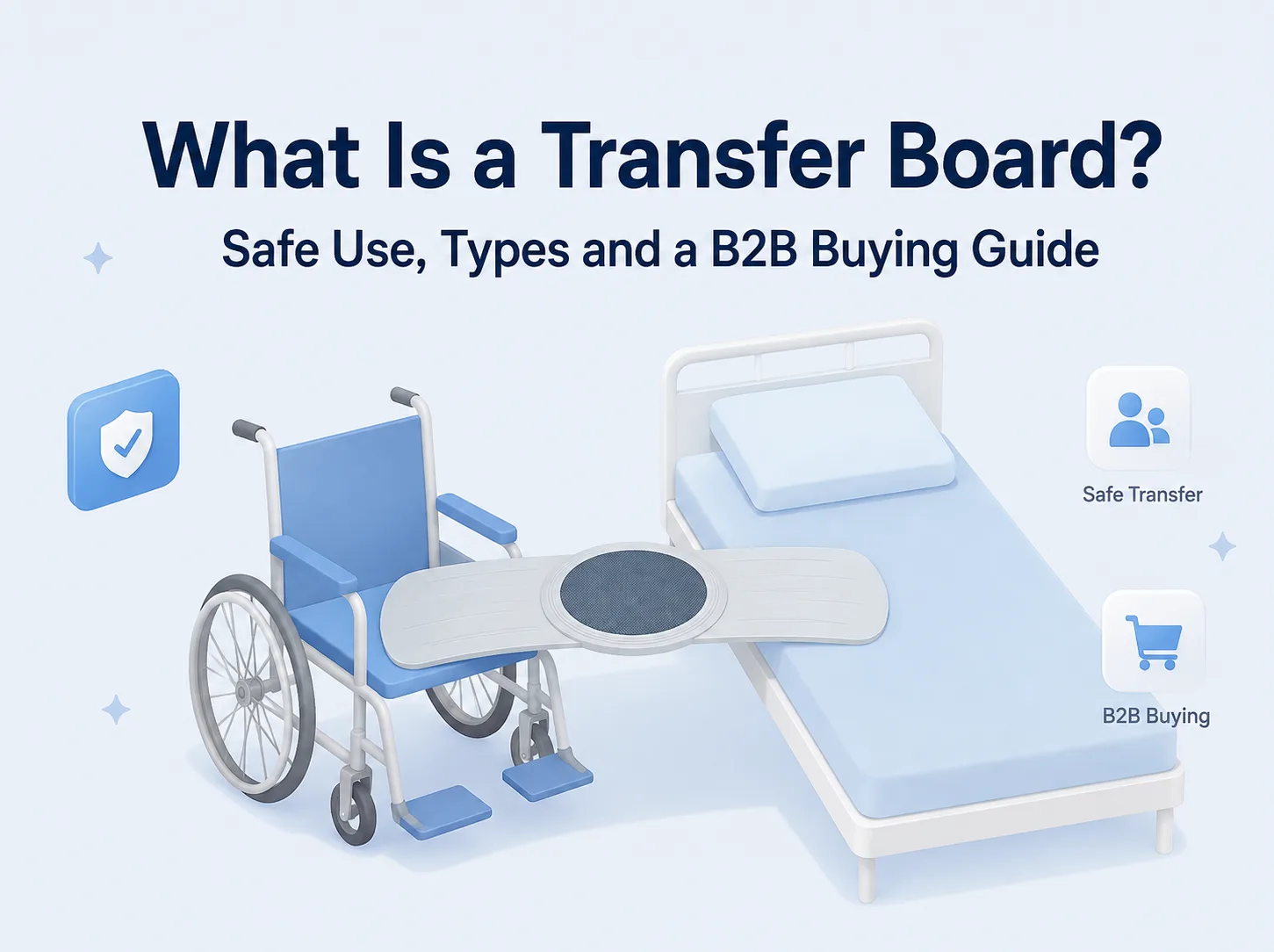
A transfer board is a simple device.
But used the wrong way, it can do more harm than good.
In this guide, you’ll learn exactly what a transfer board is, when it’s the right tool, how it’s typically used, and — if you’re sourcing for a hospital, care facility, or distribution business — what to check before you order.
Let’s dive in.
Key takeaways
- A transfer board bridges a short gap between two seated surfaces, like a wheelchair and a bed.
- It supports sliding, not lifting. That distinction matters more than most product pages let on.
- If you’re buying for a care facility or as a distributor, rated load, material, and documentation matter more than price per unit.
What Is a Transfer Board?
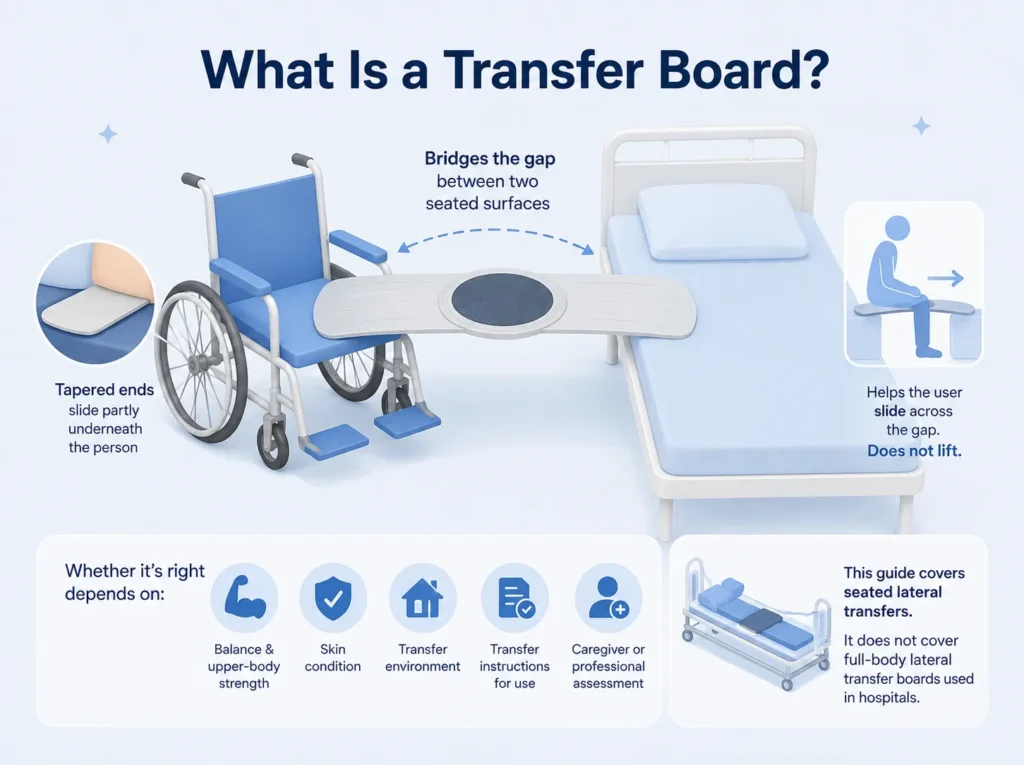
A transfer board (also called a slide board or sliding board) is a rigid device that bridges the gap between two seated surfaces.
Think wheelchair to bed. Or wheelchair to car seat.
The board is usually flat or gently curved. It’s made from a smooth, rigid material. And it’s tapered at one or both ends, so it can slide partly underneath the person using it.
Here’s the important part: a transfer board helps someone slide across a gap. It doesn’t lift them.
That’s a meaningful distinction — and one that gets glossed over a lot.
Whether a transfer board is the right tool depends on:
- The user’s balance and upper-body strength
- Their skin condition
- The transfer environment
- The specific product’s instructions for use
- A trained caregiver’s (or healthcare professional’s) assessment
One more thing before we go further.
This guide covers boards used for seated lateral transfers — wheelchair-to-bed, wheelchair-to-chair, wheelchair-to-car, and similar. It doesn’t cover full-body lateral transfer boards used in hospitals to move a patient between a bed and a stretcher or imaging table. That’s a related but different product category, with different design requirements.
What Is the Purpose of a Transfer Board?
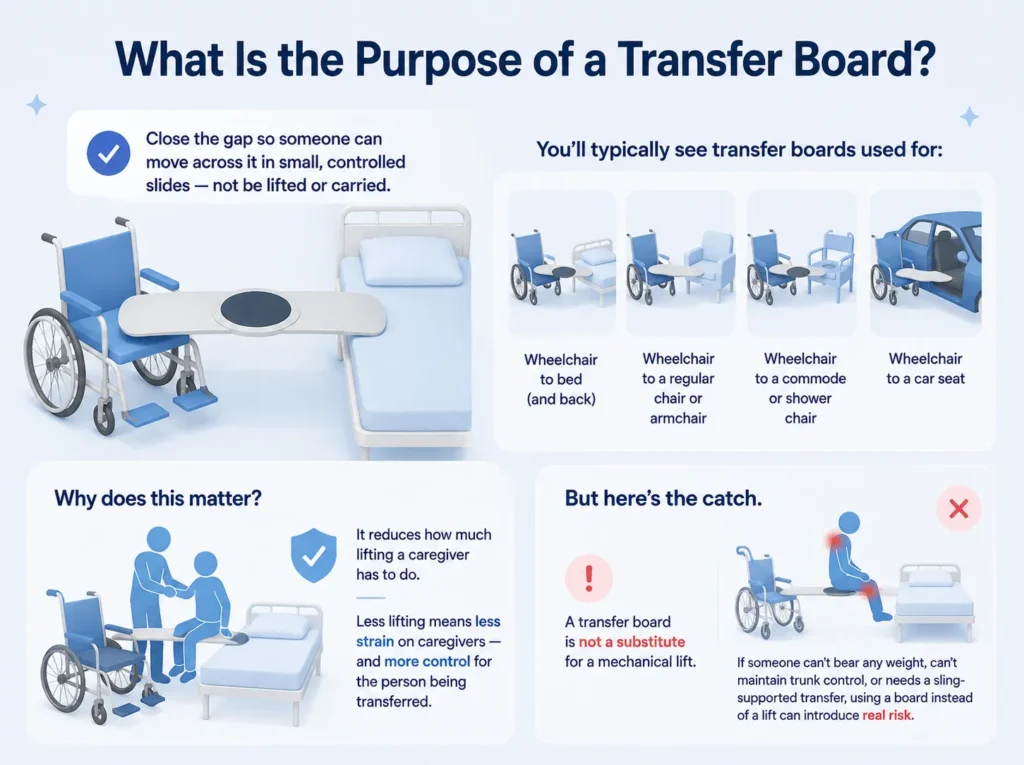
Simple: to close the gap between two seated positions so someone can move across it in small, controlled slides — instead of being lifted or carried.
You’ll typically see transfer boards used for:
- Wheelchair to bed (and back)
- Wheelchair to a regular chair or armchair
- Wheelchair to a commode or shower chair
- Wheelchair to a car seat
Here’s how it works in practice. One end of the board rests under the person. The other end rests on the destination surface. That creates a bridge across the gap.
Why does this matter?
Because it reduces how much lifting a caregiver has to do. Less lifting means less physical strain on staff or family caregivers — and more control for the person being transferred.
But here’s the catch.
A transfer board is not a substitute for a mechanical lift. If someone can’t bear any weight, can’t maintain trunk control, or needs a sling-supported transfer, using a board instead of a lift can introduce real risk.
Is a Transfer Board Right for Every Patient?
No. Not even close.
In fact, using a transfer board when it’s not appropriate is one of the more common causes of transfer-related injury.
So how do you know if it’s the right call? Use this as a starting framework — not a clinical assessment.
| Consider a transfer board when… | Reassess (or pick another method) when… |
|---|---|
| The user has some sitting balance and trunk control, or a trained caregiver is helping | The user can’t safely maintain a seated position or can’t cooperate with the transfer |
| Both surfaces are stable and can be positioned close together | The gap, height difference, or space can’t be safely controlled |
| The board is in good condition, and its rated load matches the person and situation | The board is cracked, warped, damaged, or its rated load is unknown |
| The plan follows the product’s instructions for use and the facility’s protocol | Skin condition, medical lines, or clinical status call for professional evaluation first |
One more caveat worth repeating: in a care setting, this decision — and how the transfer is carried out — should be made or confirmed by a qualified healthcare professional. A physical therapist, occupational therapist, or trained nurse, for example.
This table is a framework for thinking it through. It’s not a replacement for that judgment.
How to Use a Transfer Board Safely
Below is a general preparation checklist. Not a substitute for hands-on training. Not a replacement for your facility’s SOP. And definitely not a replacement for the product’s own instructions for use.
With that said, here’s what typically happens.
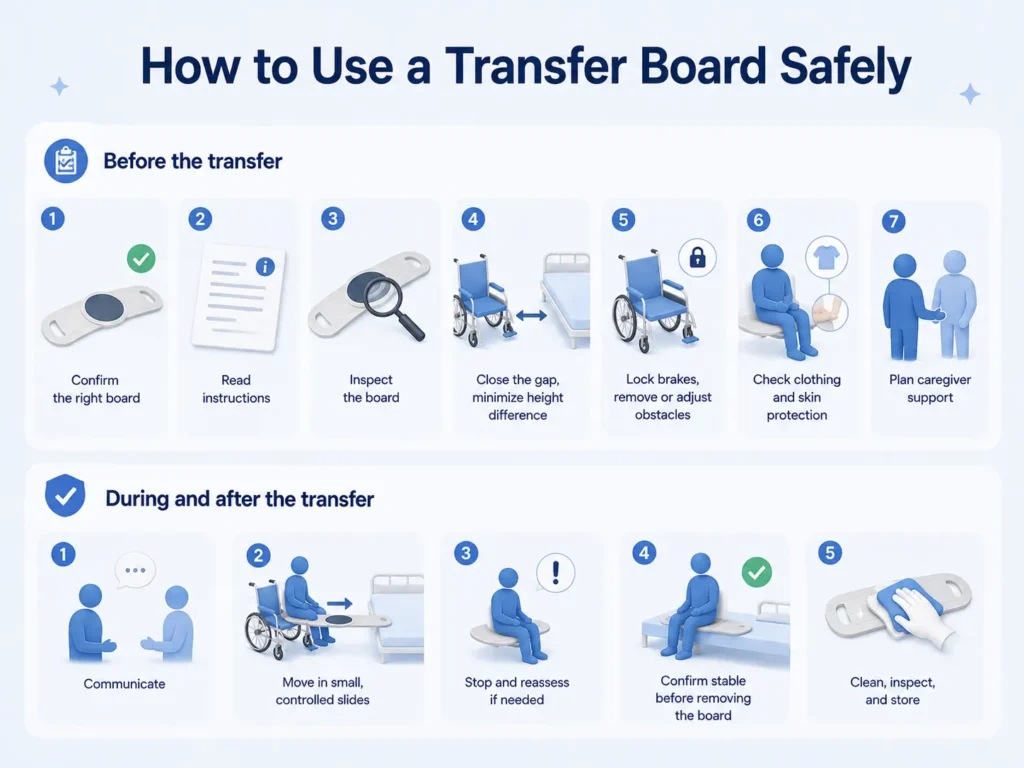
Before the transfer:
- Confirm the board is designed for this type of seated transfer.
- Read the instructions for use. Check the labeled safe working load.
- Inspect the board. No cracks, no warping, no sharp edges, no contamination.
- Position both surfaces as close together as possible. Minimize the height difference.
- Lock the wheelchair brakes. Remove or adjust armrests, footrests, or obstacles if the product allows it.
- Check clothing and skin protection at the contact points.
- Decide how many caregivers are needed — one, two, or additional equipment.
During and after the transfer:
- Communicate each step before moving.
- Move in small, controlled slides. Not one big motion.
- Stop and reassess if the board shifts, resistance spikes, or the user becomes unsteady.
- Confirm the person is stable on the destination surface before removing the board.
- Clean, inspect, and store the board per the manufacturer’s instructions.
That’s it. Simple in theory. It just takes practice — and proper training — to do consistently well.
Transfer Board vs. Slide Sheet vs. Gait Belt vs. Patient Lift
Here’s a mistake we see a lot: reaching for whichever patient-handling tool is closest, instead of the one that fits the task.
This table should help.
| Equipment | Primary role | Typical scenario | Key purchasing question |
|---|---|---|---|
| Transfer board | Bridges a short gap for seated lateral transfer | Wheelchair-to-bed, wheelchair-to-car | Does it fit the seated transfer, and does the rated load match? |
| Slide sheet | Reduces friction when repositioning someone on one surface | In-bed repositioning | Is it reusable, washable, and reliable under load? |
| Gait belt | Gives a caregiver a secure hold during walking or standing | Users who can partially bear weight | Is staff trained, and is it rated for the load? |
| Mechanical lift | Fully or partially supports body weight via a sling | Users who can’t bear weight or assist | Is the sling compatible? Is there enough space? Is staff trained? |
Bottom line: if someone can’t bear weight, can’t maintain trunk control, or the transfer distance exceeds what a board can bridge safely — reach for the lift, not the board.
Types of Transfer Boards (And Where Each One Fits)
Not all transfer boards are built the same. Here’s a breakdown.
| Type | Best-fit application | What to check |
|---|---|---|
| Straight transfer board | Direct, unobstructed transfers | Length, width, thickness, rated load |
| Curved transfer board | Routing around a wheelchair armrest or wheel | Curve geometry, contact area, overlap |
| Board with handholds | When caregivers need a secure grip | Handhold placement, edge finish, strength |
| Low-friction sliding board | Prioritizing smoother lateral movement | Surface friction, skin safety, wear resistance |
| Portable/folding board | Home care, travel, vehicle transfers | Weight, folded size, hinge durability |
| Higher-capacity board | Users needing a higher rated load | Documented rated load, structural verification |
Notice the pattern. Straight and curved designs mostly differ in how they navigate obstacles. Handholds, texture, and folding mechanisms are about handling and storage — not the transfer mechanics itself.
The takeaway? Start with the use case. Not the spec sheet.
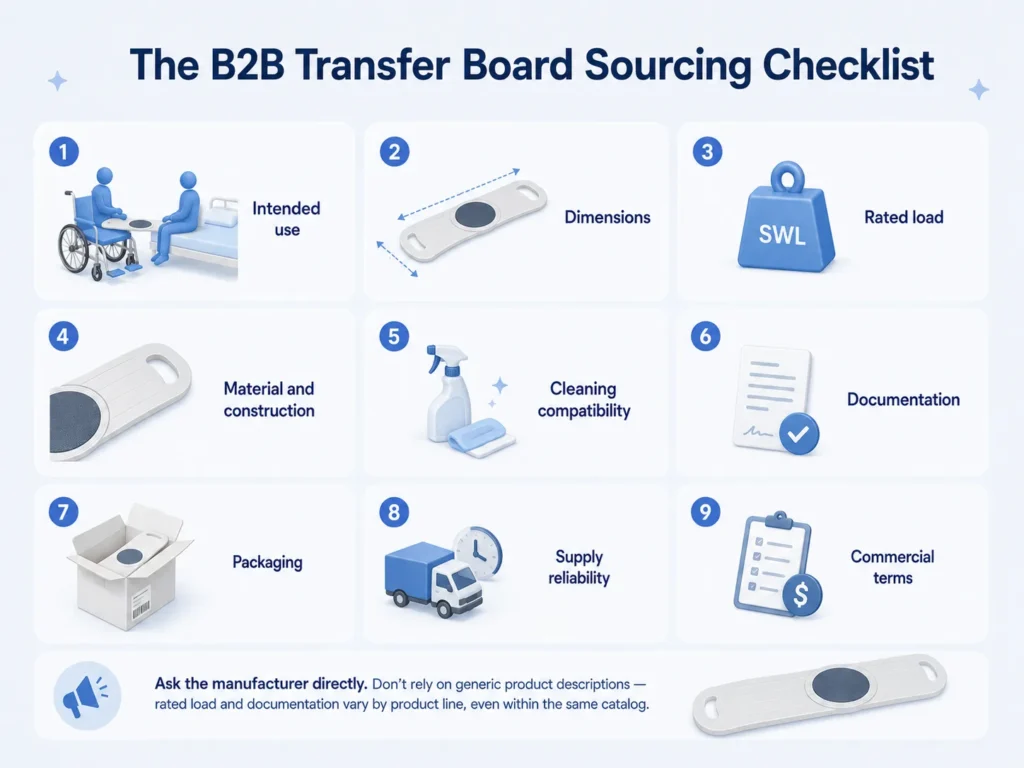
The B2B Transfer Board Sourcing Checklist
If you’re a distributor, a care facility, or a hospital procurement team, price-per-unit is the least useful comparison you can make.
Here’s what actually matters when sourcing:
- Intended use. Is it built for seated transfer, or for bed-to-stretcher lateral transfer? These aren’t interchangeable — confirm before you order.
- Dimensions. Length, width, thickness, effective transfer span, and storage size if it folds.
- Rated load. Ask for the documented safe working load, and the conditions under which it was tested.
- Material and construction. Base material, edge finishing, surface texture, handholds or reinforcements.
- Cleaning compatibility. Which cleaning agents and disinfection methods the surface tolerates without degrading.
- Documentation. Instructions for use, label artwork, batch traceability, and quality-system paperwork relevant to your market.
- Packaging. Unit packaging, carton dimensions, barcoding, manual language, OEM or private-label options.
- Supply reliability. MOQ, sample lead time, production lead time, and how the supplier handles restocking or quality issues.
- Commercial terms. Sample policy, warranty scope, and how quality deviations get handled on repeat orders.
Ask the manufacturer directly. Don’t rely on generic product descriptions — rated load and documentation vary by product line, even within the same catalog.
A Quick Decision Matrix for Healthcare Buyers
Different buyers care about different things. Here’s a shortcut.
| Buyer profile | Top priority | Focus your evaluation on | Next step |
|---|---|---|---|
| Home-care distributor | Portability, ease of use | Size, weight, packaging | Confirm packaging and included instructions |
| Rehabilitation provider | Range of user abilities | Straight vs. curved design, training materials | Test samples against real scenarios |
| Nursing-home supplier | Frequent use, frequent cleaning | Durability, cleaning compatibility, consistency | Request cleaning/maintenance docs |
| Hospital procurement | Standardization, risk control | IFU, rated load, traceability | Route through internal transfer-aid review |
| Medical-device distributor | Sellability, stable supply | OEM options, MOQ, lead time | Submit sourcing requirements for a quote |
Sourcing a Transfer Board for Vietnam and Southeast Asia
Disclosure: Delifecare is a Vietnam-focused medical-care product platform within our business network. This section is general sourcing information — not a personalized recommendation.
If you’re sourcing transfer boards for Vietnam or Southeast Asia, three things usually decide the outcome:
- Does the product spec actually match your use case?
- Is documentation available in the language you need?
- Can the supplier keep supply and communication consistent over repeat orders?
Before requesting a quote, have this ready: the intended application, your target user group, expected order volume, and any documentation requirements. It speeds up the entire conversation.
Explore Delifecare’s Transfer Board product page for specifications, or reach out to start a sourcing conversation for the Vietnamese market.
FAQs About Transfer Boards
What is the purpose of a transfer board?
To bridge a short gap between two seated surfaces — like a wheelchair and a bed — so someone can slide across instead of being lifted.
Can you use a transfer board by yourself?
Sometimes. If someone has enough sitting balance and upper-body strength, they may be able to use a board independently after being assessed and trained by a healthcare professional. Others need a caregiver’s help. This should be assessed case by case — never assumed.
How do you use a transfer board safely?
Generally: position both surfaces close together, place the board to bridge the gap, and move across in small, controlled slides while a caregiver assists as needed. Always follow the product’s instructions for use and any facility-specific protocol.
What’s the difference between a transfer board and a slide sheet?
A transfer board is rigid and bridges a gap between two surfaces. A slide sheet is a low-friction fabric used to reposition someone on a single surface — like in bed. It’s not designed to bridge a gap.
Can a transfer board be used for wheelchair-to-car transfers?
Some boards are designed or commonly used for this. But it depends on the height difference between the wheelchair and car seat, available space, and the user’s ability. Check the product-specific guidance first.
How do healthcare buyers choose a transfer board supplier?
They typically compare rated load, material and cleaning compatibility, available documentation, packaging options, and how consistently the supplier delivers quality across repeat orders.
What documents should distributors request from a manufacturer?
At minimum: instructions for use, rated-load documentation, label artwork, and any quality-system or compliance paperwork relevant to your target market.
Medical and safety notice
This guide provides general information about transfer boards and related sourcing considerations. It is not medical advice and does not replace individual assessment, hands-on transfer training, or instructions from a qualified healthcare professional. Always follow the product’s instructions for use and your organization’s transfer protocols.
About Haody Medical
Haody Medical is the international medical-products business of Suzhou Haody Medical Products Co., Ltd., established in 2008. We work with healthcare distributors, care providers and international buyers on medical textile and patient-care product solutions. Our content team creates practical product and sourcing resources to help buyers evaluate intended use, product specifications, documentation and supply requirements before making purchasing decisions.
Learn more about Haody Medical, our manufacturing capabilities and our medical-product portfolio.