
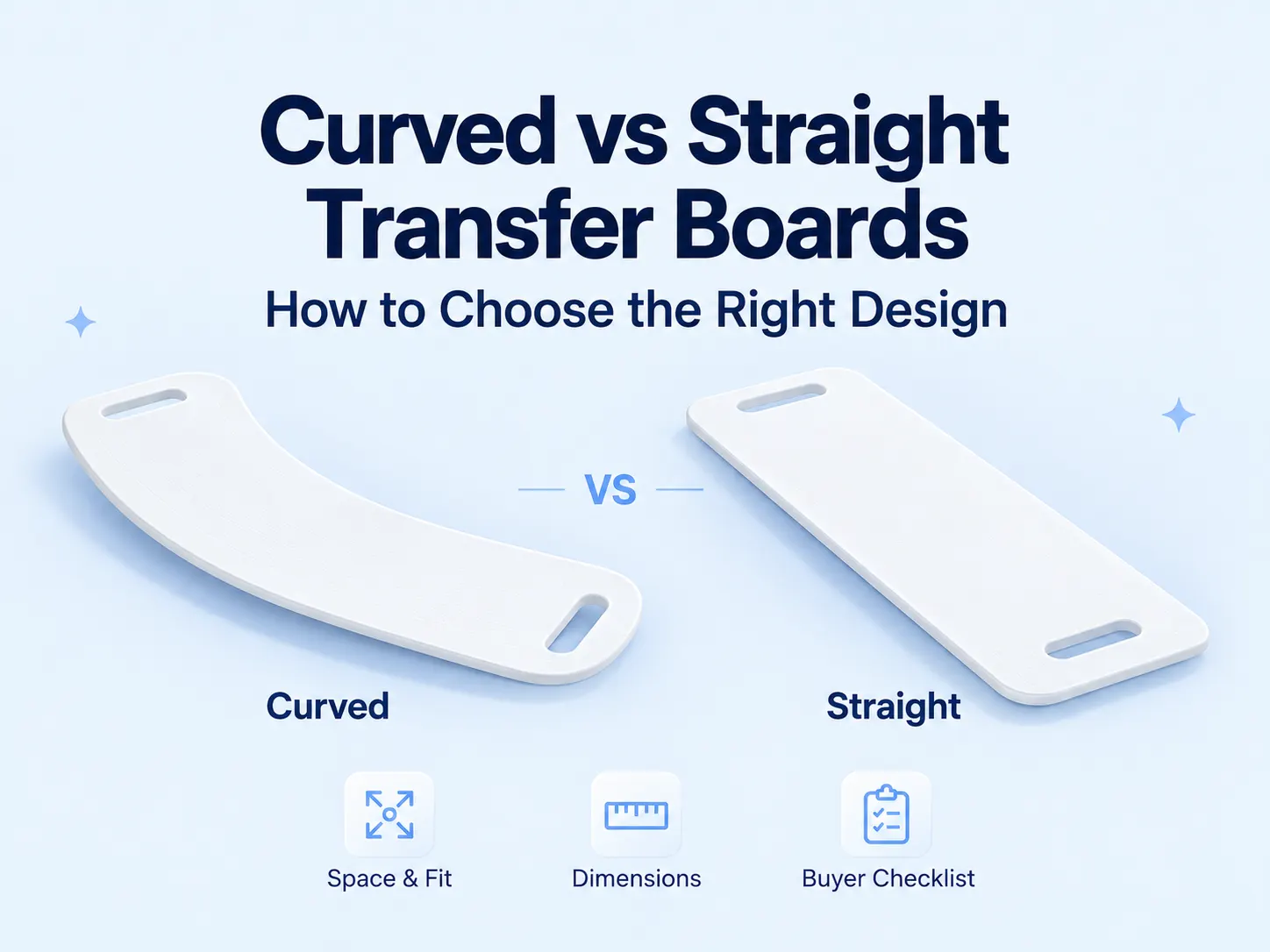
A straight transfer board offers a simple, direct bridge between two surfaces. A curved board is shaped to sit around a wheelchair wheel or fit a particular layout. Neither shape is universally safer. The right choice depends on the equipment, the space, the specific model, the manufacturer’s instructions, and a professional assessment of the person using it.
This article compares the two shapes for seated transfers. It is not a step-by-step tutorial. For definitions and general board types, see our guide to transfer board types and intended uses. The second half is written for distributors, rehabilitation providers, and care-facility buyers. It covers what to measure, how to compare quotes, and how to evaluate samples.
Curved vs Straight Transfer Boards: Key Differences at a Glance
Shape mainly affects how a board fits the space and equipment around a transfer. It does not tell you the load rating, the support requirements, or whether a board suits a given person. Those depend on the exact model and on individual assessment.
| Comparison point | Straight transfer boards | Curved transfer boards |
|---|---|---|
| Outline | A more direct board profile | An arc-shaped profile. The curve varies by model |
| Space fit | Check the direct path and positioning room | Check curve direction, obstacles, and end placement |
| Support requirements | Confirm against the model’s instructions | Confirm as well. A curve does not reduce them |
| Dimensions | Length, width, thickness, contact area | The same, plus the curve and end outline |
| Rated load | A property of the specific model | A property of the specific model. It cannot be inferred from the curve |
| Material and cleaning | Follow the material and manufacturer’s instructions | Follow the material and manufacturer’s instructions |
| Buying basis | Match to real use conditions | Match to real use conditions |
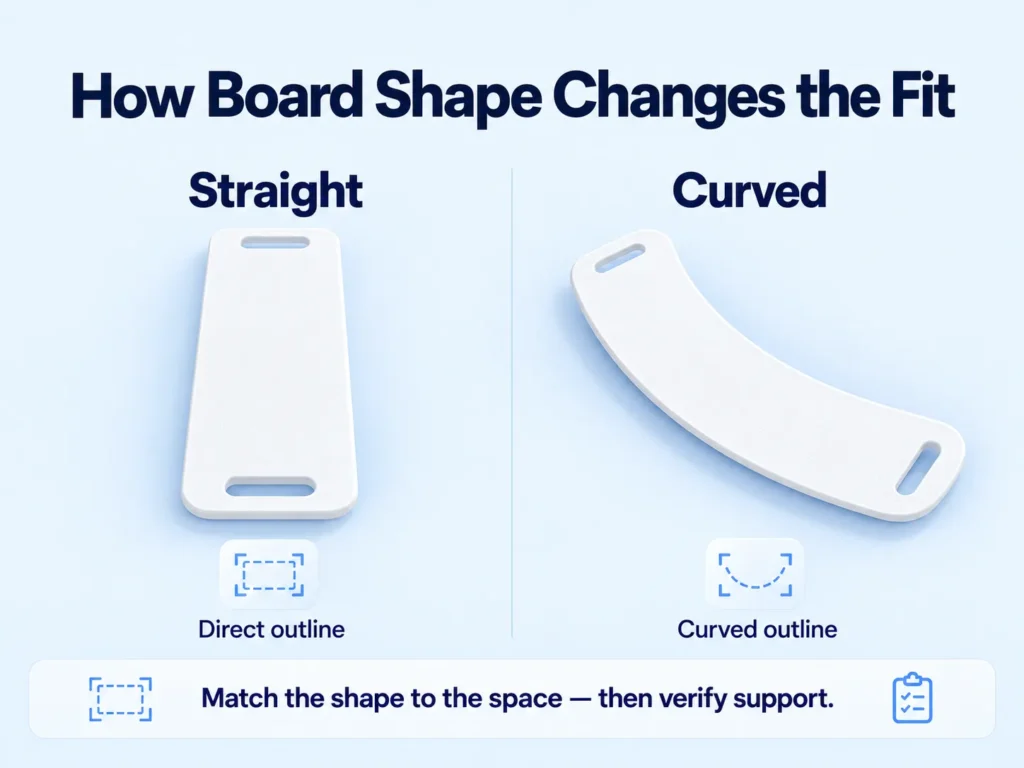
What Does the Board’s Shape Actually Change?
Shape changes how a board sits between two surfaces and how it works around nearby parts of the equipment. It does not change what the board is rated for.
Straight Boards and Direct Transfer Paths
A straight board gives a plain bridge when the path between two surfaces is clear. The NSW Agency for Clinical Innovation describes straight boards as typically long wooden or plastic boards. It lists use on and off a commode and in and out of a car, and possibly from a bed to a power wheelchair.
Straight boards are not limited to bed-to-chair moves. They can suit many layouts, provided the support points and positioning space work in the real setting.
Curved Boards and Obstacle Clearance
NSW ACI describes a curved board as one that curves around the wheel. It positions it as an alternative to the over-wheel slider, in a range of lengths and widths. In practice, a curve may help with positioning around a wheelchair wheel.
Check three things before relying on that curve:
- Which way the curve runs.
- Where each end will land.
- Whether both ends have adequate support.
An arc does not mean the board can clear a fixed armrest or any other obstacle. That depends on the model and the equipment.
Curved, Notched, Sliding, and Rotating Are Different Features
Product names alone are not enough to identify a board’s structure or intended use. Before comparing models, request an outline drawing, current product images, and instructions for use. Confirm whether the board is straight or curved, whether it has a notch, and whether it includes any moving or rotating components. Use these details—not the product name—to determine what you are comparing.
Which Shape Fits Your Transfer Environment?
Use the setting to narrow your options, then let measurements and assessment decide the model. Both shapes may work in the same setting.
Wheelchair-to-Bed or Chair Transfers
Check how closely the chair can approach, the condition of both seat surfaces, and where the wheels and armrests sit. UMass Memorial Health notes that transfers are easier between surfaces of similar height, or to a slightly lower one. Its guidance has the wheelchair as close to the bed as possible, and it may have the nearest armrest removed.
Either shape could be considered here. For setup and safety preparation, see our wheelchair-to-bed transfer setup guide.
Wheelchair-to-Commode Transfers
Look at the shape of the commode seat, the area where the board can be supported, and compatibility with the equipment. NSW ACI lists straight boards for commode transfers, and notes that a satin or silk cover can be fitted to a straight board for added skin protection. A curved shape is not a “commode-only” feature. In wet areas, confirm the material and cleaning suitability for each model.
Wheelchair-to-Car Transfers
Check the door opening, the height difference between seats, the gap, and the positioning conditions. A longer board does not fix every gap or height problem. Confirm limits with the manufacturer’s instructions and a qualified professional. UMass Memorial Health also says car transfers should follow the steps given by the person’s therapist or physician.
What Should Buyers Measure Before Requesting a Quote?
Record the real transfer setup before asking suppliers for a recommendation. Suppliers can then check product limits against actual conditions, rather than quoting from a product name. The table below can be copied into a quote request.
| Information to record | What the buyer should provide | What needs confirmation |
|---|---|---|
| Starting and target equipment | Equipment models, seat types, use setting | Whether this matches the product’s intended use |
| Actual gap | Gap in the planned position, with photos | Whether it falls within the model’s stated limits |
| Seat heights | Height of each side and the difference | Whether it fits the instructions for use |
| Support area | Size and shape of the contact area on both sides | Whether each board end can be properly supported |
| Obstacles | Positions of wheels, armrests, other parts | Whether the board can be positioned around them |
| Surrounding space | Room to place and remove the board, and for care | Whether the working space is adequate |
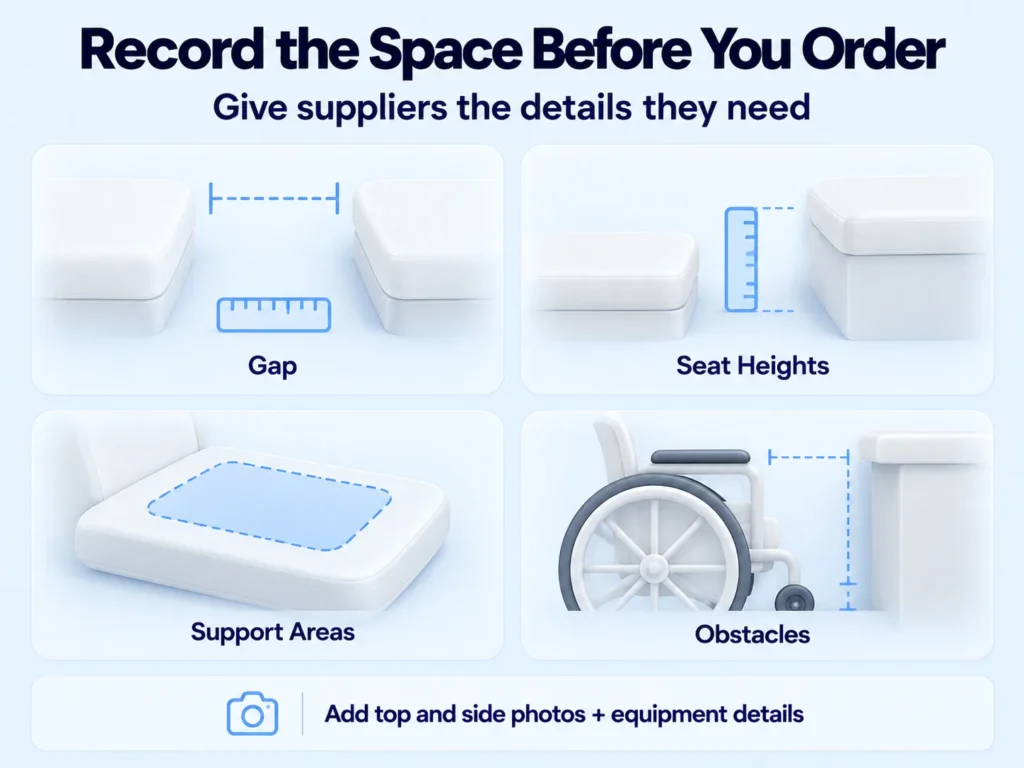
Send annotated top-view and side-view photos with equipment models and clear measurement units. Remove any personal identifying information. Responsibilities are separate: the buyer supplies the environment details, the supplier checks product limits, and a qualified professional confirms fit for the individual.
Why Board Length and Weight Capacity Are Not Enough
Length and a headline load number are easy to compare, but they leave out what determines whether a board suits your setup. Two quotes with the same figures can describe boards with different outlines, support requirements, and documentation.
Overall Length Is Not the Same as Permitted Gap
Overall length, the supported end areas, and the gap a board may span are three different things. For curved boards, also review the outline drawing, because the longest dimension alone says little about the shape. We do not give a universal “rule of thumb” for overlap or span here. Use the manufacturer’s stated limits for the specific model.
Match the Load Claim to the Exact Model and Conditions
A rated load belongs to a specific model, tested or documented under stated conditions. NSW ACI also advises confirming that the person’s weight is compatible with the board’s safe working limit. Ask for labels and documents that name the exact model. Ask which support conditions and limitations apply. Don’t rank boards on numbers whose conditions are unknown, and don’t invent your own safety-margin formula.
Use this template to compare suppliers side by side:
| Specification to verify | Supplier A | Supplier B |
|---|---|---|
| Exact model and specification revision | To be confirmed | To be confirmed |
| Dimensions and outline drawing | To be confirmed | To be confirmed |
| Rated load and stated limitations | To be confirmed | To be confirmed |
| Support and gap requirements | To be confirmed | To be confirmed |
| Material, top surface, and underside design | To be confirmed | To be confirmed |
| Cleaning instructions and included accessories | To be confirmed | To be confirmed |
How to Evaluate Samples Before Bulk Ordering
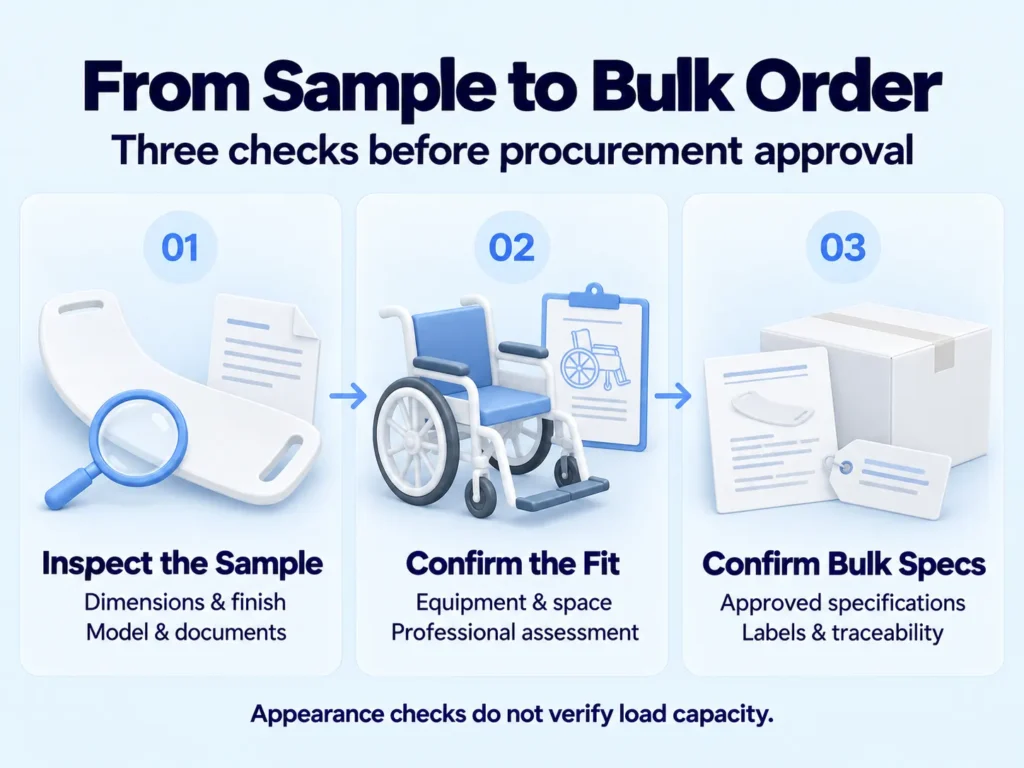
Separate three things: what you can check by looking at the sample, what needs documents, and what needs professional assessment. Mixing them up is how a sample approval turns into a false sense of assurance.
Stage 1 — Inspect the Sample and Verify Documents
- Confirm the model, outline, and dimensions match the ordered specification.
- Check the edges, the top surface, the underside contact areas, and any accessories.
- Check that the label, instructions, and technical documents all refer to the same model.
A visual check cannot verify load capacity or confirm fit for a person. Don’t run destructive load tests on a sample yourself.
Stage 2 — Confirm Fit in the Intended Environment
Have someone with the right competence assess fit, following the instructions for use and your organization’s procedures. Record which equipment it was assessed with, the conditions of use, and any limits found. A trial with a real person is not a routine goods-in check. It belongs inside a professional assessment.
Stage 3 — Document What the Bulk Order Must Match
Write down what production has to match:
- Sample number and specification version.
- Material, dimensional tolerances, surface, labeling, and accessories.
- Packaging, batch traceability, change-notification terms, and how exceptions are handled.
Keep appearance and dimension acceptance apart from performance requirements that need supporting documents.
Frequently Asked Questions
Is a Curved Transfer Board Safer Than a Straight Board?
No. Neither shape is universally safer. Safety depends on how well the model fits the equipment and setup, on an individual assessment, and on correct use under the manufacturer’s instructions and professional guidance.
Is a Banana Transfer Board the Same as a Curved Transfer Board?
“Banana board” is a common nickname for a curved board. Names vary by seller and region, so verify the actual outline, dimensions, and intended use of the model rather than relying on the name.
Can a Curved Board Be Used with Fixed Wheelchair Armrests?
A curved shape does not guarantee it. It depends on the equipment, the board model, how it is positioned, and a professional assessment. Check the instructions and ask the manufacturer before assuming it will work.
How Do I Choose the Right Transfer Board Length?
There is no universal length. Base it on your actual positioning, the support area at each end, and the manufacturer’s limits for the model. Use the measurement table above and share it with the supplier.
What Should Distributors Request Before Ordering Samples?
Request:
- The intended use and the exact model and dimensions.
- Load documentation tied to that model.
- The instructions for use and cleaning requirements.
- Packaging and labeling information.
Request Transfer Board Specifications for Your Application
Work in this order: use and environment, then shape and size, then model documents, then sample confirmation. If you are sourcing for a distributor, clinic, or care facility, tell us the use case, the equipment involved, your target market, expected quantities, and any packaging or labeling needs. Include the models you want checked. Then request transfer board specifications from our team.