
Both Are “Compression Stockings” — But They Solve Different Problems
Walk into any medical supply catalog and you’ll find compression stockings in two main lengths: knee-high and thigh-high (also called mid-thigh). They look similar, they’re often made from the same fabrics, and they’re frequently priced confusingly close. So which one does a patient actually need — and as a distributor or pharmacy buyer, which mix should you stock?
This guide breaks down the differences by pressure class, medical indication, patient comfort, and logistics — so you can match the right product to the right buyer, every time.
First, Understand the Pressure: What Compression Classes (CCL) Mean
Compression strength is measured in millimeters of mercury (mmHg). The stocking is knitted with graduated pressure — strongest at the ankle, decreasing up the leg — to push venous blood back toward the heart and reduce venous hypertension.
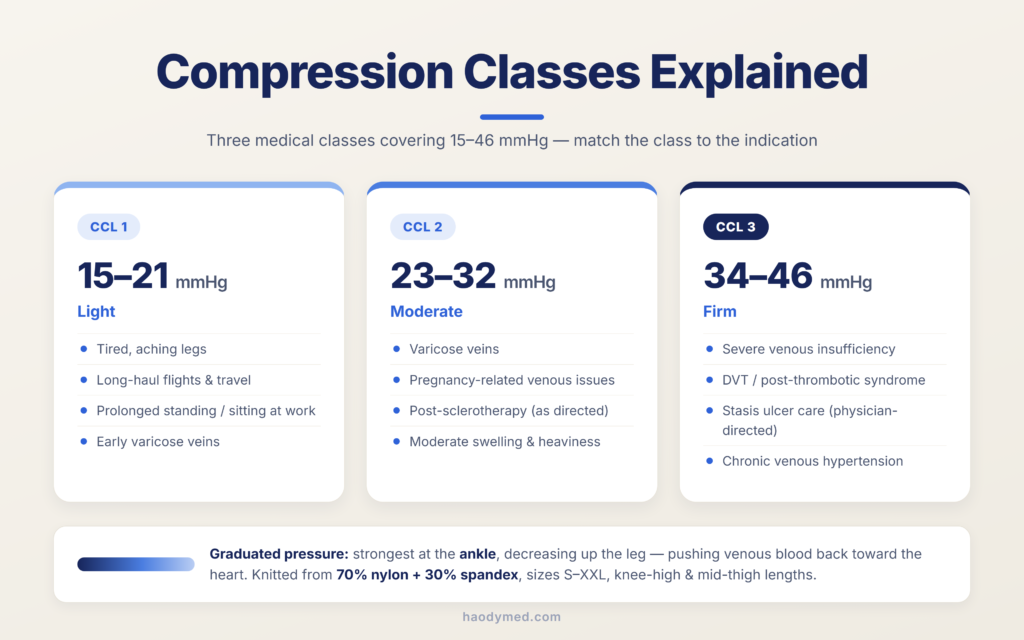
Three compression classes covering 15–46 mmHg — from daily fatigue to severe venous disease
Our medical compression stockings are available in three classes:
| Class | Pressure | Typical Use |
|---|---|---|
| CCL 1 (Light) | 15–21 mmHg | Tired, aching legs; long flights; occupation-related fatigue; early varicose veins |
| CCL 2 (Moderate) | 23–32 mmHg | Varicose veins; pregnancy-related venous issues; post-sclerotherapy (as directed) |
| CCL 3 (Firm) | 34–46 mmHg | Severe venous insufficiency; DVT / post-thrombotic syndrome management; stasis ulcer care (physician-directed) |
Note: classification systems vary by market (EU RAL, German KKKS, US FDA-cleared labeling are not identical). Confirm the standard your market requires before tendering.
Knee-High Compression Stockings
Knee-highs (our model NO. 002101) deliver graduated compression from the ankle up to just below the knee — which is where the majority of venous stasis and swelling problems begin.
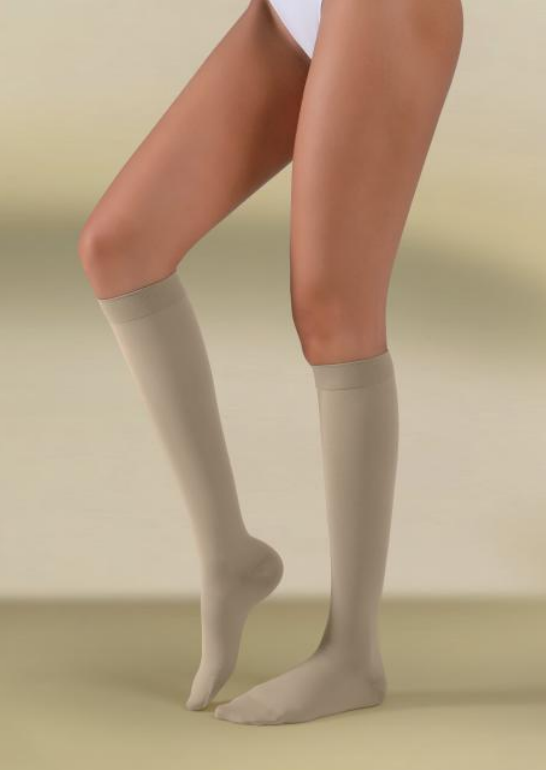
Knee-high compression stockings — graduated support foot to below the knee
Best suited for:
- Everyday venous insufficiency, ankle and calf swelling
- Varicose veins confined below the knee
- Pregnancy-related leg fatigue
- Long-haul travel and occupations requiring prolonged standing/sitting
- Post-sclerotherapy of lower-leg veins (as directed by a physician)
Why buyers stock more of them:
- Easier to put on — the #1 driver of patient compliance. A stocking that never gets worn has zero clinical value.
- Cooler and more comfortable in warm climates — critical in Southeast Asia, the Middle East, and Southern Europe.
- Lower price point drives higher retail turnover.
- Fewer sizing failures: fewer measurement points mean fewer returns.
Thigh-High (Mid-Thigh) Compression Stockings
Thigh-highs (our model NO. 002201) extend graduated compression above the knee to the upper thigh, managing venous hypertension across the whole limb.
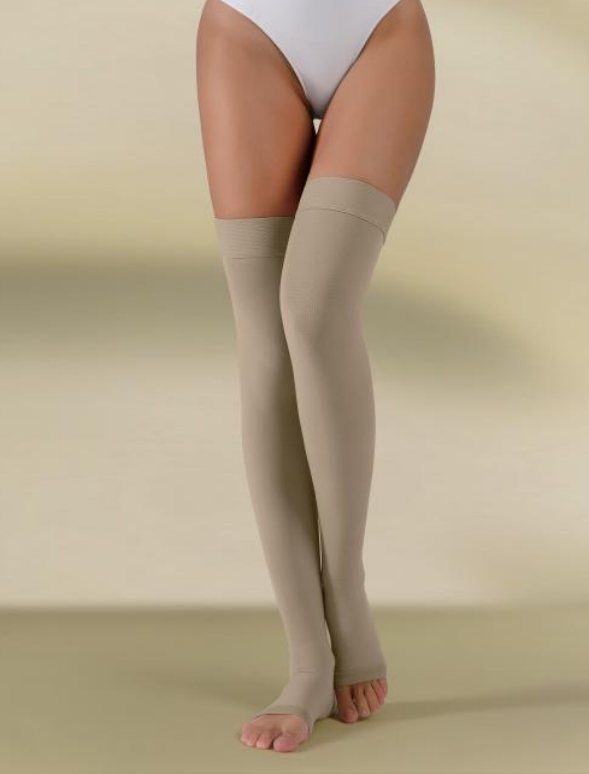
Mid-thigh compression stockings — open-toe option with stay-up band, coverage to upper thigh
Best suited for:
- Varicose veins extending above the knee
- Post-surgical recovery and hospitalization (including DVT prophylaxis protocols)
- Thigh-level venous insufficiency where swelling or disease crosses the knee
- Patients with knee-joint mobility issues where a knee-high band would irritate
Trade-offs to communicate to patients:
- Harder to don and doff — the stay-up band keeps them in place but adds donning friction
- Rolling or slipping at the thigh is the most common compliance complaint
- Higher unit price; larger size matrix in your inventory
Head-to-Head Comparison
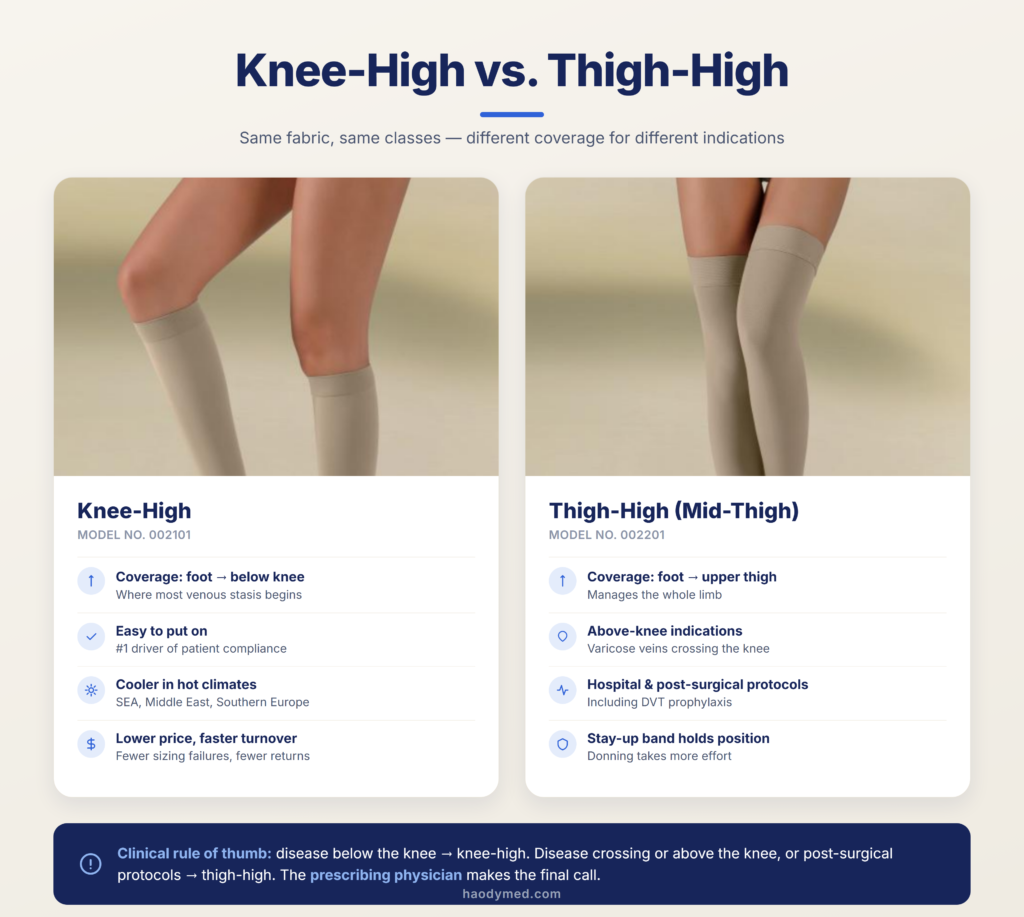
Disease below the knee → knee-high. Disease crossing or above the knee → thigh-high.
| Factor | Knee-High | Thigh-High |
|---|---|---|
| Compression zone | Foot → below knee | Foot → upper thigh |
| Donning ease | Easy | Challenging |
| Patient comfort (hot climates) | Better | Warmer |
| Above-knee indications | No | Yes |
| Price point | Lower | Higher |
| Return/exchange rate | Lower | Higher (sizing complexity) |
| Retail turnover | Fast | Moderate |
Clinical rule of thumb: disease below the knee → knee-high. Disease that crosses or originates above the knee, or hospital/post-surgical protocols → thigh-high. The prescribing physician makes the final call — never let a retail recommendation replace it.
Material & Sizing (Where Most Returns Come From)
Both models are knitted from 70% (±2%) nylon + 30% (±2%) spandex — the spandex delivers the sustained graduated pressure, while the nylon keeps the knit smooth, durable and skin-friendly. Available in beige, black and multi-color, sizes S–XXL.
Compression stockings fail in the field for one dominant reason: wrong size. Measure first thing in the morning, before swelling builds:
- Ankle circumference at the narrowest point
- Calf circumference at the widest point
- Knee-high length: floor to knee bend
- For thigh-high, add: thigh circumference and floor to upper thigh
The full S–XXL measurement chart is available on request — ask us before placing a first order.
Common Buying Mistakes (and How to Avoid Them)
- Stocking only one length. Pharmacies and home-care dealers need both; the mix depends on your market’s hospital protocols.
- Ignoring donning aids. Stocking butts and donning gloves dramatically improve compliance — high-margin accessories worth bundling.
- Treating “mmHg” as interchangeable between standards. CCL classes are not identical across EU RAL and US-labeled product — confirm the standard before tendering.
- Buying non-certified product. For medical-grade stockings, always ask the manufacturer for certification and test documentation applicable to your market — we provide it on request.
Frequently Asked Questions
Are thigh-high stockings always “better” because they’re longer?
No. Longer is not stronger. If the venous problem is confined below the knee, a properly fitted knee-high delivers the required graduated compression with better comfort and compliance. Thigh-highs are indicated when disease or protocol requires above-knee coverage.
Can compression stockings be worn at night?
Generally no — unless specifically prescribed (e.g., certain post-surgical cases). Horizontal lying position already assists venous return. Follow the physician’s instruction.
What’s the difference between diabetic socks and compression stockings?
Diabetic socks protect fragile skin with seamless, non-binding construction and only 3–5 mmHg micro-pressure; compression stockings actively support circulation with graduated 15–46 mmHg pressure. They serve different patients — see our guide: What Are Diabetic Socks?
Do you supply both lengths for wholesale/OEM?
Yes. We manufacture both knee-high (NO. 002101) and mid-thigh (NO. 002201) compression stockings in CCL 1–3, sizes S–XXL, with OEM/ODM support for branding, packaging and colorways. Contact us with your market and certification requirements.
The Bottom Line
Knee-highs win on comfort, price, and compliance; thigh-highs win when the indication extends above the knee. Stock both, size carefully, and let the prescription — not the price tag — make the medical decision.
Disclaimer: This article is for informational purposes only and is not medical advice. Compression therapy should be initiated on the advice of a qualified physician.
Browse our full range: compression stockings · hospital & diabetic socks · all products