Search “tubular bandage,” and you’ll get a wall of products that all look the same.
Same shape. Same name. Completely different jobs.
Here’s the problem: the name only tells you the shape. It doesn’t tell you what the bandage is actually built to do.
A tubular bandage is a seamless, tube-shaped medical textile used for dressing retention, protective coverage, or light support — and which one it does depends entirely on the material and construction, not the label. In fact, elastic tubular bandages are classified by the FDA as Class I medical devices intended to “support and compress a part of the patient’s body,” which underscores why construction and intended use — not the generic name — determine the correct product.
In this guide, you’ll learn:
- What a tubular bandage actually is (and why the name is misleading)
- The 3 functions it’s used for — and why they’re not interchangeable
- How to size it correctly (most guides skip the part that matters most)
- The right way to apply it, step by step
- What to specify before placing a bulk order
Let’s get into it.
What Is a Tubular Bandage, Exactly?
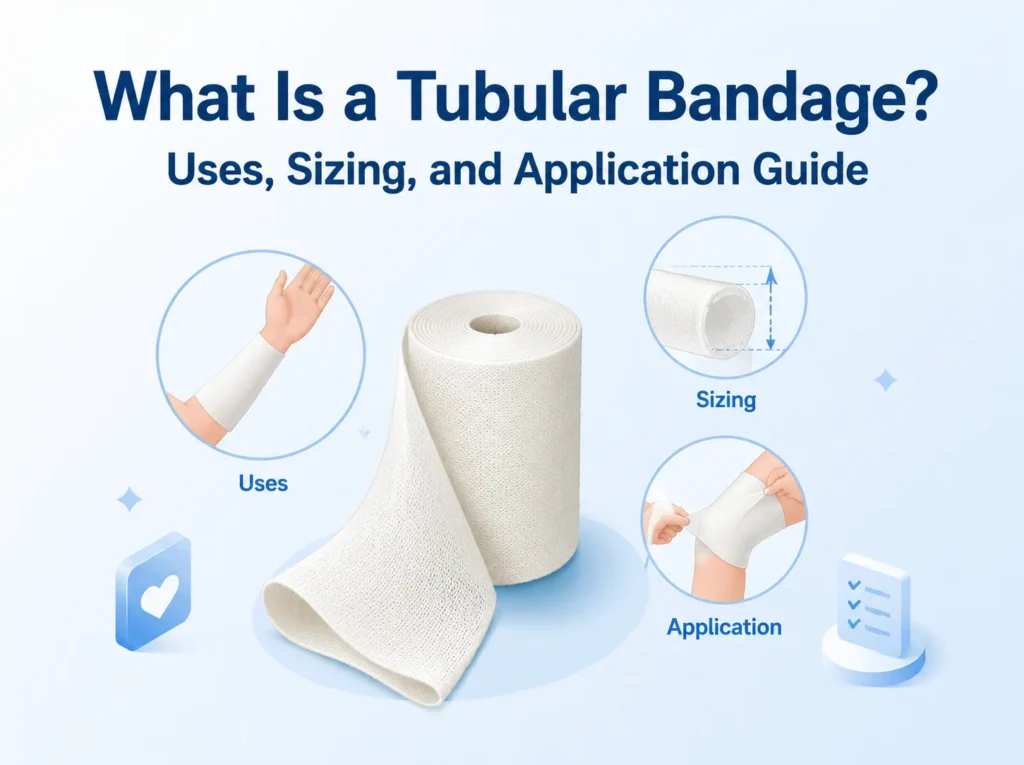
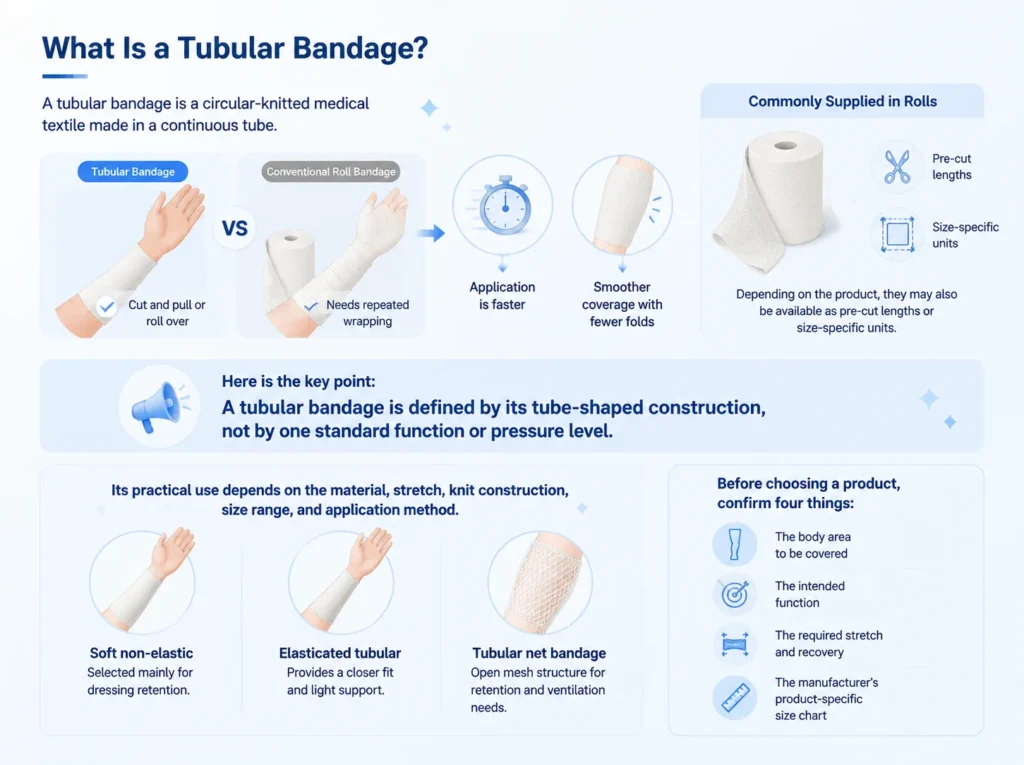
A tubular bandage is a seamless, knitted fabric tube. You pull it over a body part instead of wrapping it around like a roll bandage.
That single design difference is the whole appeal. No unwinding. No repositioning halfway through. No uneven tension. You measure, cut, pull it on like a sleeve, and you’re done.
But here’s where the confusion starts: construction varies wildly between products, even when they’re sold under the exact same name.
Four things determine what a tubular bandage actually does:
- Fiber composition — cotton, viscose, polyester, or blends, each affecting softness, breathability, and durability
- Knit structure — dense knit for coverage, or open mesh for airflow and flexible retention
- Elasticity — some are built with elastic yarn for stretch and recovery, others aren’t
- Supply format — continuous rolls cut to length, or pre-cut pieces
The takeaway: function follows construction, not the name on the box. Two products both labeled “tubular bandage” can solve completely different problems.
What Are Tubular Bandages Used For?
Most tubular bandages fall into one of three buckets:
1. Dressing retention
This is the most common use case. The bandage holds a primary dressing in place — especially on limbs and joints, where tape loosens fast with movement.
Retention products are lighter and less elastic than support bandages. Their job isn’t to compress anything. It’s to stay put.
2. Protective coverage
Some tubular bandages exist purely as a soft outer layer — over sensitive skin, over an existing dressing, or anywhere friction is a concern. Softness and comfort matter more than stretch here.
3. Light support (gentle compression)
Elasticated versions provide even, gentle support around a limb or joint. Compression products in this category are commonly graded by pressure level — typically low (around 5–10 mmHg), medium (10–20 mmHg), or high (20–30 mmHg) — with the appropriate level depending on the clinical need and the manufacturer’s guidance. Never assume the compression level based on the product category name alone; always confirm against the specific product’s rated pressure range.
Bottom line: figure out which of these three jobs you need done before you compare a single product. A retention bandage used as a support bandage will underperform every time — and vice versa.
Tubular Bandage Types: Don’t Choose by Name Alone
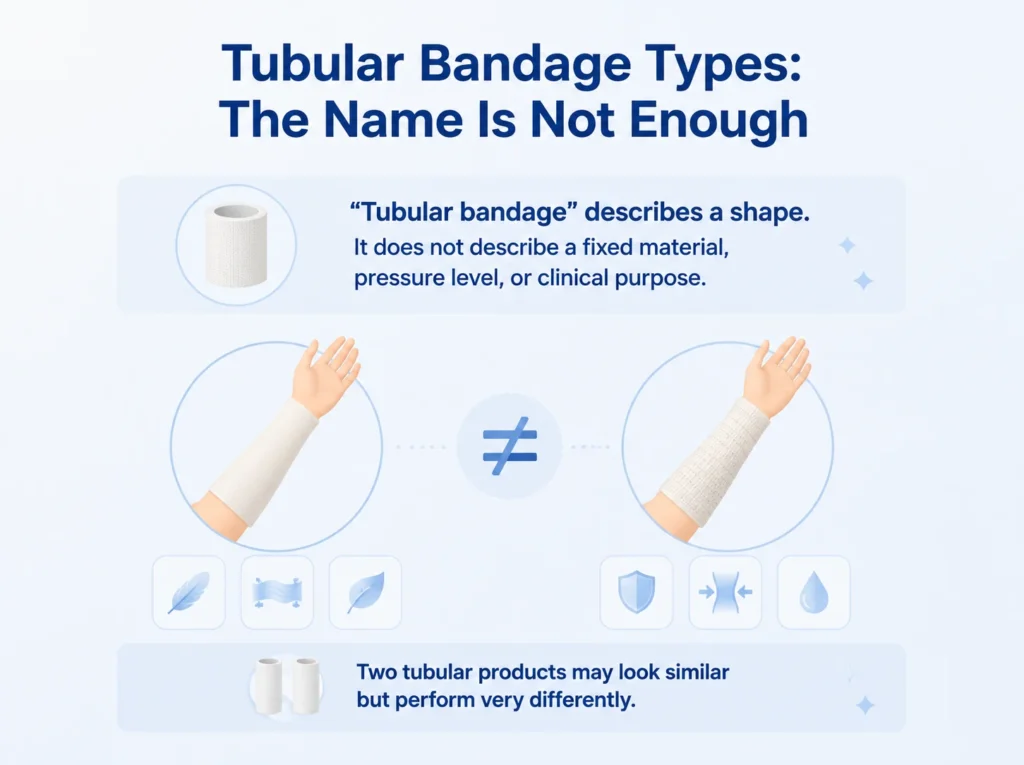
Here’s something most buying guides skip entirely: “tubular bandage” describes a shape, not a performance standard.
Two products can sit in the same catalog category and look nearly identical on a spec sheet — and behave completely differently once applied.
Dressing-retention tubular bandages
Lightweight, soft, low-tension. Built for comfort and stability, not compression. Use one as a support bandage, and it’ll just slip.
Elasticated tubular support bandages
Elastic yarn gives these stretch and recovery, for a more even fit. Whether a specific product works single-layer or double-layer — and how much support it actually delivers — comes from the manufacturer’s instructions, not a general rule.
Tubular net bandages
Open mesh instead of dense knit. Prioritizes breathability and flexible fixation over coverage. Solves a different problem entirely — mainly securing dressings where dense fabric would be impractical. (Full comparison in our tubular bandage vs. tubular net bandage guide.)
Know which of these three you’re actually looking at before you compare prices or MOQs. Otherwise you’ll end up with a product that matches the search term but not the job.
How to Choose the Right Tubular Bandage Size
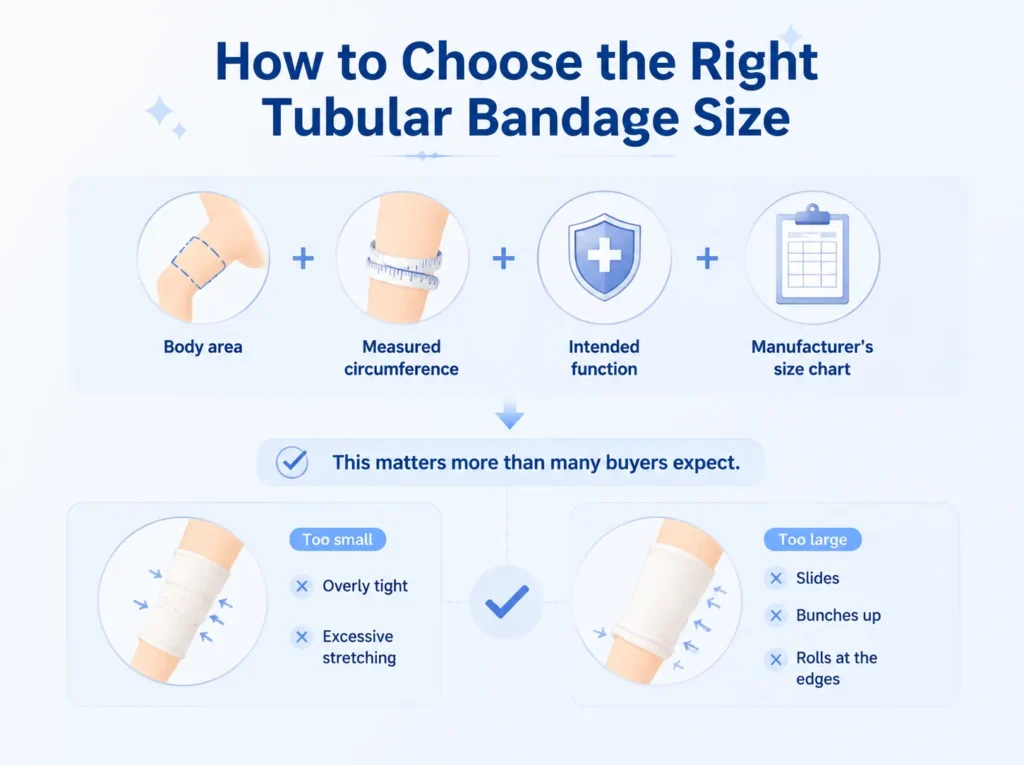
Sizing isn’t “small, medium, large.” It’s matching two measurements — width and length — to the body area and function.
Step 1: Measure circumference first
Measure the actual body area — finger, wrist, forearm, ankle, calf, knee, or upper arm. If it spans a joint or changes circumference along its length, check the product’s own guidance instead of assuming one measurement covers it all.
Step 2: Don’t stop at width — check finished length too
This is where most sizing guides fall short. The flat width matters, but so does the finished length once it’s cut and applied. Right width, wrong length, and you’ll end up too tight, too loose, or bunched at the ends.
Step 3: Match fit to function
- Retention: secure, no added pressure
- Support: enough stretch for even tension, without cutting off circulation
- Protective coverage: comfortable, no excessive tightness anywhere
Too small creates pressure points. Too large rolls, slips, or bunches (more on that below).
What to confirm before you buy:
- Body area and measured circumference → determines sizing range
- Bandage type (retention, protection, support) → same width fits differently by type
- Flat width and finished length → both affect final fit
- Stretch and recovery → affects consistency over time
- Single- or double-layer method → changes required cut length
- Product-specific size chart → not standardized across brands
That last point is worth repeating: size charts aren’t universal. Sizing ranges vary meaningfully between manufacturers — for example, one widely used sizing reference maps “Size C” to roughly 15–25 cm circumference, while another brand’s compression-based chart uses a different range entirely for a similarly labeled size. Always size against that specific product’s chart — never a generic reference or a competitor’s chart.
How to Apply a Tubular Bandage
Once you’ve got the right product and size, application is simple. A few small steps separate a clean fit from a bandage that rolls within the hour.
- Confirm product type and size. Retention, protection, or support — double-check before you cut anything.
- Cut to the required length. Rolled products need cutting to spec. Single-layer vs. double-layer use changes the required length, so check the manufacturer’s guidance rather than eyeballing it.
- Apply without overstretching. Pull or roll it into place gently — think sleeve or sock. Overstretching during application is one of the most common reasons a bandage ends up too tight or prone to rolling later.
- Check the fit. No folds, wrinkles, or visible tension lines. If it’s part of a clinical care plan, follow product instructions and any guidance from a qualified healthcare professional.
Tubular Finger Bandages: A Different Sizing Game
Small body areas — fingers and toes — play by different rules.
Less surface area plus constant joint movement means tighter fit tolerance. A size that’s slightly off is far more noticeable on a finger than on a forearm.
Some finger bandages use an applicator for faster, more consistent placement — useful in settings where the same product gets applied repeatedly throughout the day. Whether you need one depends on the product and the workflow, not a universal rule.
If you’re sourcing finger bandages: confirm the supported size range and applicator compatibility before finalizing the spec.
Why Tubular Bandages Roll, Bunch, or Slip
These complaints come up constantly — and the cause is almost always identifiable.
| Issue | Likely cause | Quick fix |
|---|---|---|
| Edge rolling | Size, cut length, or stretch doesn’t match the application | Recheck circumference and product size |
| Wrinkles/bunching | Fabric wasn’t smoothed during application | Remove, reapply, smooth flat before securing |
| Slipping | Construction doesn’t match the retention need | Review elasticity — you may need a different product type |
| Excessive tightness | Size too small, or overstretched during application | Stop use, check against the size chart |
Pro tip: if the issue persists after resizing and reapplying, the product category itself is probably wrong for the job — for example, using a retention bandage where you actually need a support product.
What Buyers Should Specify Before Ordering
For distributors and private-label buyers: “tubular bandage” isn’t a spec. It’s a starting point.
1. Define the function first
Dressing retention, protective coverage, light support, or some combination — decide this before you compare a single supplier. Everything else follows from it.
2. Lock in the technical specs
- Fiber composition and blend ratio
- Flat width and size range
- Finished length / roll length
- Stretch percentage and recovery behavior (and rated compression level in mmHg, if applicable)
- Knit density or mesh structure
- Color options and size-coding system
- Market-specific requirements
“Similar to what we ordered last time” is not a spec. It produces inconsistent results across production runs.
3. Nail down packaging and distribution
- Roll format vs. individually packed vs. retail-ready
- Label language, barcoding, instruction inserts
- Outer carton markings for warehousing
- MOQ, sample lead time, approval sample requirements
4. Approve the sample against the full spec
Before bulk production, check the sample for:
- Material feel vs. agreed fiber composition
- Actual sizing vs. the stated size chart
- Stretch and recovery performance
- Knit or mesh construction
- Packaging and labeling accuracy
Skip this step, and you’re the one dealing with sizing complaints after the product’s already shipped. For OEM orders especially, put approval criteria in writing — a signed spec sheet or reference sample — so every future run has a fixed standard.
Having produced tubular bandages for wound-care distributors across multiple international markets since 2008, we’ve found that the most consistent production runs are the ones where the buyer approves a signed spec sheet before the first bulk shipment — not after a resizing complaint.
Related Medical Textile Products
A tubular bandage rarely gets sourced alone. It usually shows up alongside:
- Net tubular bandage — breathable dressing fixation where dense coverage isn’t the priority
- Finger bandage — sized for small, high-movement areas
- Cotton stockinette — padding and general medical textile applications
- Cellulose acetate medical fabric — non-adherent, permeable wound-contact material
FAQ
What is a tubular bandage used for?
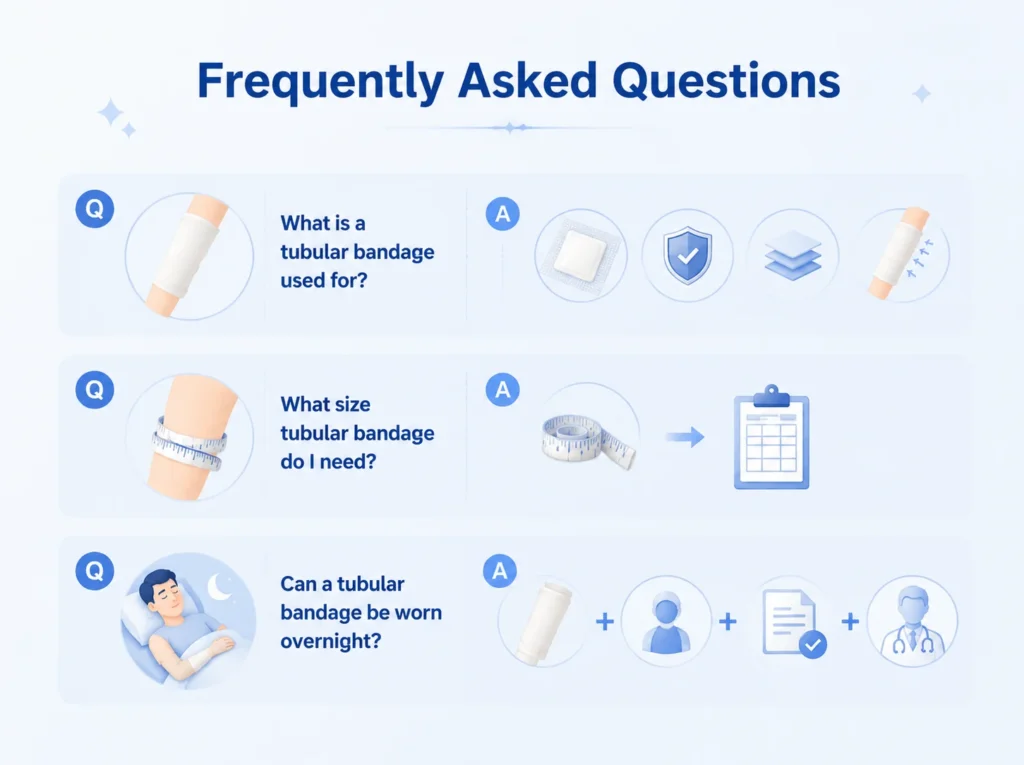
Dressing retention, protective coverage, light support, or layering — depending on the product’s material and construction. Not every tubular bandage is built for the same job.
What size tubular bandage do I need?
Measure the body area’s circumference and match it against the manufacturer’s own size chart. Sizing systems vary by supplier, so don’t rely on another brand’s chart.
Can a tubular bandage be worn overnight?
Depends on the specific product and application. Follow the manufacturer’s instructions, and consult a qualified healthcare professional when medical guidance is needed.
Final Thoughts
A tubular bandage isn’t one standard product. It’s a shape applied to at least three different jobs: holding a dressing in place, protecting skin, or providing light support.
Match the construction to the job, get the sizing right, and application takes care of itself.
For bulk buyers: a clear spec and an approved sample upfront save you from the sizing and consistency headaches that only surface after the order’s already shipped.
Looking for tubular bandages in custom sizes, materials, or private-label packaging? Contact Haody Medical to discuss your product specifications, sample requirements, and bulk-order needs.
Written by the Haody Medical Product Team | Medically reviewed for accuracy.
Haody Medical is an ISO 13485-certified medical textile manufacturer producing medical products since 2008, supplying medical textile products to distributors across multiple international markets.
This article provides general product and educational information only. It is not medical advice. Product selection and use should follow the manufacturer’s instructions and applicable professional guidance.