Quick answer: Cellulose acetate mesh is an open-knit dressing substrate. On its own, it’s not a finished wound dressing. It becomes one once a manufacturer adds a petrolatum emulsion, a honey-based formulation, a CMC coating, or a silicone system, then converts, packages, sterilizes, and validates it. This guide covers how the mesh fits into that system, which finished products it’s typically used for, and exactly what to specify when you’re sourcing it.
If you’re developing a non-adherent gauze, an oil-emulsion dressing, a honey-impregnated wound dressing, or a tubular finger dressing, keep reading. We’ll walk through the mesh’s role in each format, the sourcing checklist to bring to a supplier conversation, and where the line sits between “material supplier” and “finished-device manufacturer.”
In this guide:
- Why knitted cellulose acetate mesh is used as a dressing substrate
- How it works inside a non-adherent dressing system
- The four finished-product formats it’s typically built into
- What to specify when sourcing it
- Processing and validation considerations
- FAQs
Why Cellulose Acetate Mesh Is Used as a Dressing Substrate
This guide focuses on cellulose acetate mesh as a substrate within a finished non-adherent dressing system. If you need a broader introduction to the material itself — including its composition, textile characteristics, and general medical-fabric applications — read our overview of cellulose acetate medical fabric.
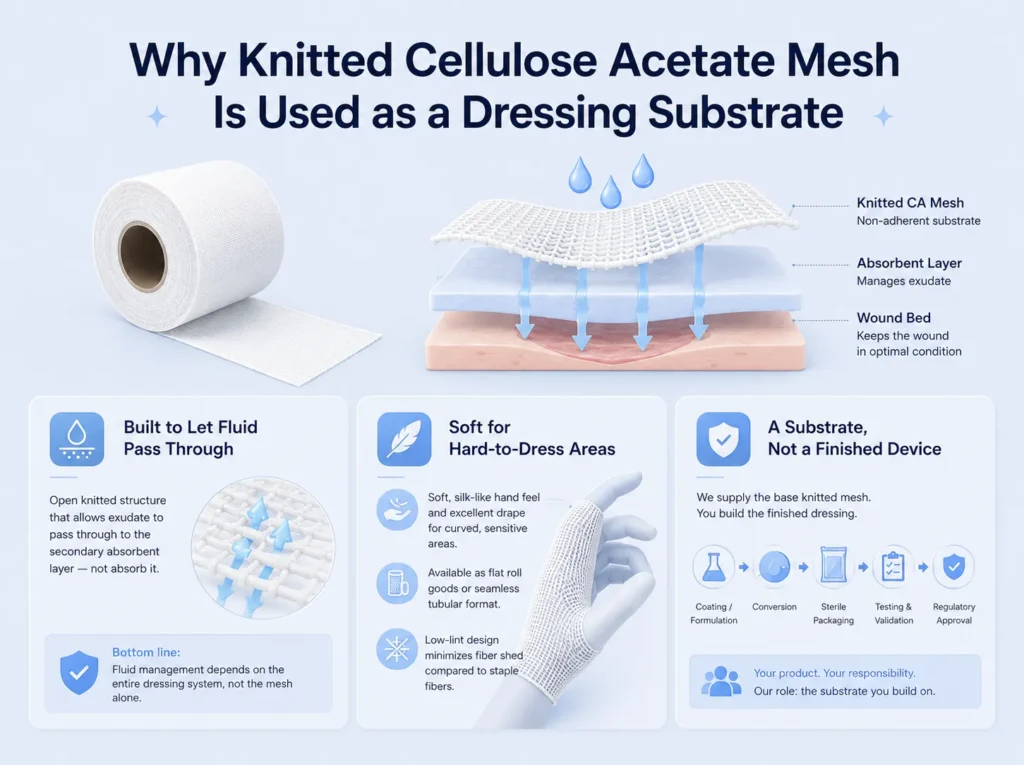
It’s built to let fluid pass through, not soak it up
The defining feature of this material is its open, knitted structure. It isn’t an absorbent pad.
It’s a gate.
In a finished dressing, wound exudate moves from the wound bed, through the mesh, and into a secondary absorbent dressing sitting on top of it. That’s the same basic construction behind most commercial non-adherent primary dressings on the market today.
Bottom line: the mesh’s job is to stay out of the way of fluid movement. How much exudate a finished dressing can actually handle comes down to the whole stack — the mesh, the coating on it, and the absorbent layer behind it — not the mesh in isolation.
It’s soft enough for the hard-to-dress areas
Knitted cellulose acetate has a soft, silk-like hand feel and bends easily. That’s why it shows up in dressings built for fingers, joints, burn sites, and skin graft donor areas — the curved, sensitive spots where stiff fabric doesn’t cooperate.
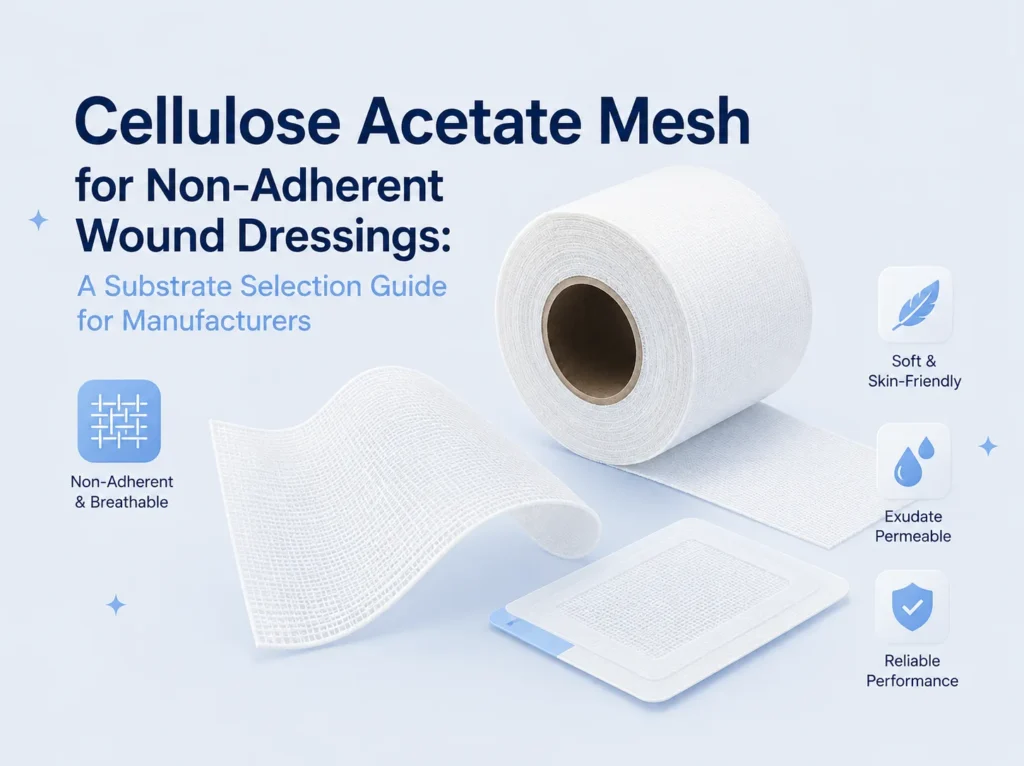
It can be supplied as flat roll goods, cut to size. It can also be knitted as a seamless tube, which opens up finger and digit dressing formats without a flat-to-tube conversion step.
One more practical detail: filament-based cellulose acetate yarn tends to shed less than staple-fiber fabrics like cotton gauze. Fewer loose fibers left behind in a wound bed is a real advantage. That said, treat this as a property to test and specify for your finished product, not as an unconditional guarantee.
It’s a substrate — not a finished medical device
Worth saying plainly: what we supply is a dressing substrate, not a finished wound dressing.
Getting to “finished dressing” requires a formulation or coating system, a conversion process, sterile packaging, biocompatibility assessment, performance validation, and regulatory documentation — all owned by the company bringing the finished device to market. Our role is the base knitted mesh, in roll or tubular format, that you build your product around.
How Cellulose Acetate Mesh Works Inside a Non-Adherent Dressing
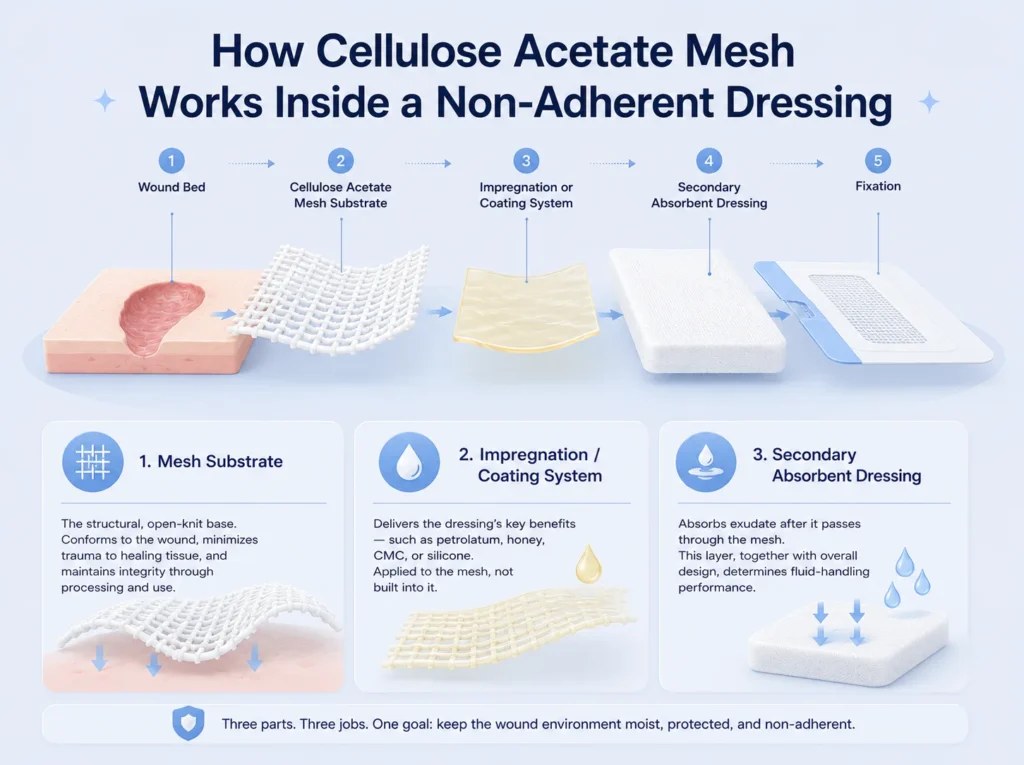
Strip a typical non-adherent dressing down to its layers and it looks like this:
Wound bed → cellulose acetate mesh substrate → impregnation or coating system → secondary absorbent dressing → fixation
Three parts do three different jobs.
The mesh substrate is the structural, open-knit base. It conforms to the wound, doesn’t cling to healing tissue the way plain cotton gauze can, and holds its shape through processing, cutting, and rolling.
The impregnation or coating system is where most of a finished dressing’s marketed benefit actually comes from — a petrolatum emulsion, a honey-based formulation, a CMC finish, or a silicone tack layer. This isn’t a theoretical setup: one well-known non-adhering primary dressing on the market is literally knitted cellulose acetate fabric impregnated with a specially formulated petrolatum emulsion, and a silicone-coated version of the same product line uses the identical open-mesh base with a soft-tack silicone finish instead.
The secondary absorbent dressing does the actual work of absorbing exudate once it passes through the mesh. For higher-exudate wounds, it’s this layer — plus the overall product design — that determines fluid-handling capacity, not the base mesh by itself.
4 Finished Dressing Formats Built on Cellulose Acetate Mesh
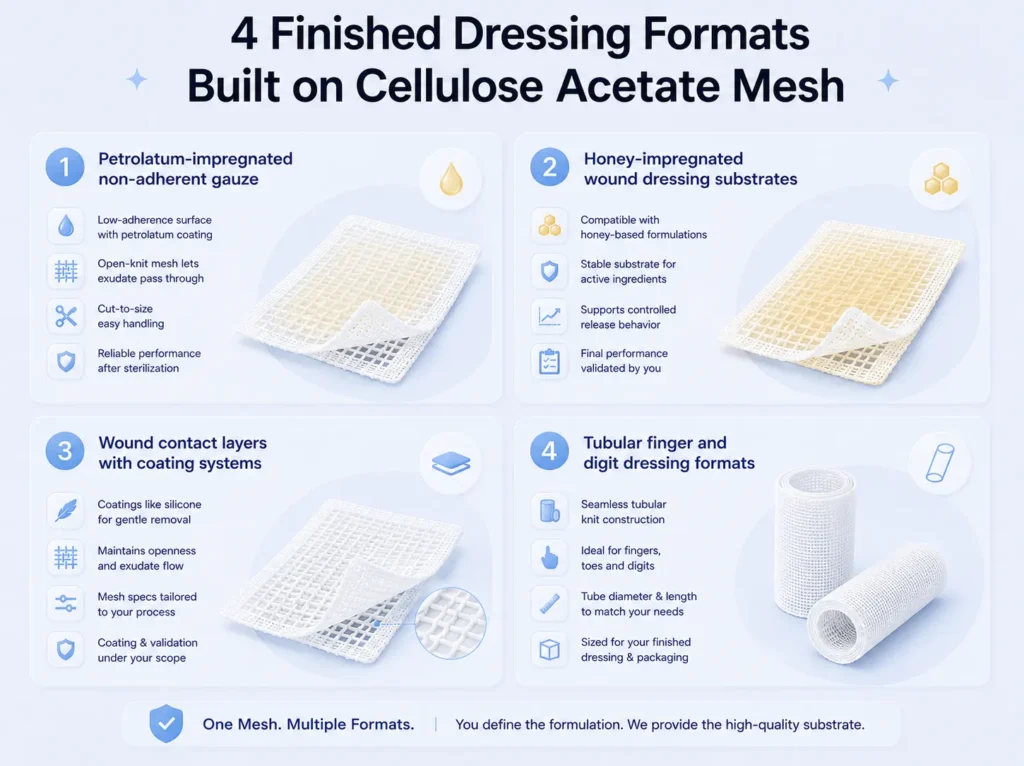
1. Petrolatum-impregnated non-adherent gauze
This is the most established use case for this material in wound care, and the product type most consistently linked to it across major wound-care brands and distributors.
The mesh gets impregnated with a petrolatum or oil-emulsion coating to create a low-adherence surface, while the open-knit structure still lets exudate reach a secondary dressing.
Development variables to lock down: impregnation weight and uniformity, mesh openness after coating, cut-to-size handling, post-sterilization performance of the coated fabric.
2. Honey-impregnated wound dressing substrates
Honey-based wound dressings — Manuka honey formulations included — are another established application for acetate gauze substrates, sometimes paired with additional active agents.
We can discuss the mesh as a candidate substrate for this kind of formulation. Formulation compatibility, active-ingredient stability, release behavior, and finished-product validation stay on your side of the table. We don’t market our base mesh as antimicrobial or wound-healing on its own — those claims belong to the validated finished device, not the substrate.
3. Wound contact layers with coating systems
Beyond petrolatum, some finished dressings pair cellulose acetate mesh with other coatings — silicone, for example — to build a contact layer that lifts off with minimal disturbance to healing tissue.
If this is your target format, we can work through mesh openness, thickness, and conversion requirements to fit your coating process. The coating itself and its performance validation remain your development scope.
4. Tubular finger and digit dressing formats
The same mesh can be knitted as a seamless tube instead of flat sheeting — useful for finger, toe, and digit dressings that need to slip on without seams or overlaps.
Roll length, tube diameter, and cutting requirements get discussed against your target finished-dressing size and packaging format.
What to Specify When Sourcing Cellulose Acetate Mesh
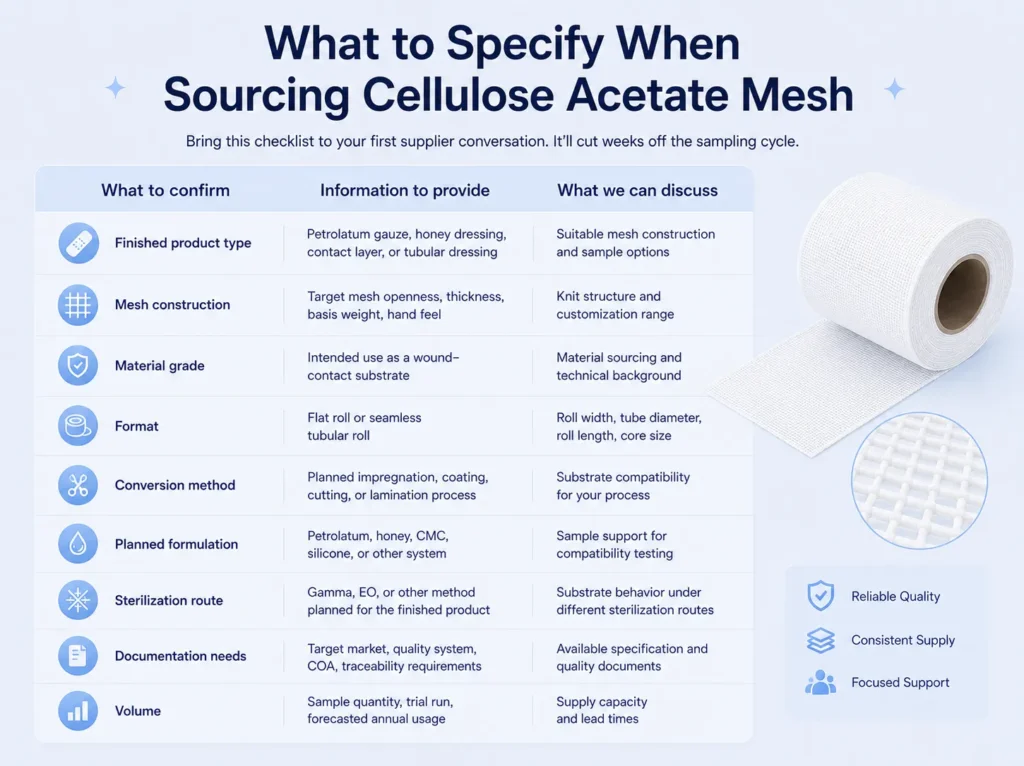
Bring this checklist to your first supplier conversation. It’ll cut weeks off the sampling cycle.
| What to confirm | Information to provide | What we can discuss |
|---|---|---|
| Finished product type | Petrolatum gauze, honey dressing, contact layer, or tubular dressing | Suitable mesh construction and sample options |
| Mesh construction | Target mesh openness, thickness, basis weight, hand feel | Knit structure and customization range |
| Material grade | Intended use as a wound-contact substrate | Material sourcing and technical background |
| Format | Flat roll or seamless tubular roll | Roll width, tube diameter, roll length, core size |
| Conversion method | Planned impregnation, coating, cutting, or lamination process | Substrate compatibility for your process |
| Planned formulation | Petrolatum, honey, CMC, silicone, or other system | Sample support for compatibility testing |
| Sterilization route | Gamma, EO, or other method planned for the finished product | Substrate behavior under different sterilization routes |
| Documentation needs | Target market, quality system, COA, traceability requirements | Available specification and quality documents |
| Volume | Sample quantity, trial run, forecasted annual usage | Supply capacity and lead times |
Processing and Validation Considerations
Formulation compatibility
Whatever gets coated or impregnated onto the mesh needs testing for viscosity, coating uniformity, and whether the mesh openness survives the coating process well enough to still transfer fluid. Migration and stability after packaging and storage belong in your development testing too.
Wet-state handling
Cellulose acetate loses tensile strength when wet. That means the finished dressing’s intended handling — including removal during a dressing change — needs testing under realistic wet-use conditions, not assumptions from dry-state fabric data.
This matters most for higher-exudate wounds, where the finished product design (not the substrate alone) has to account for wet-strength requirements.
Sterilization and packaging
Gamma irradiation and ethylene oxide are both generally workable sterilization routes for cellulose acetate-based materials. High-temperature steam autoclaving isn’t recommended — it can degrade fiber performance.
Whichever route you choose, validate it on the finished, packaged product, coating included. Don’t extrapolate from raw-substrate data alone.
Regulatory responsibility
Supplying a substrate isn’t the same as bringing a finished medical device to market. Confirming intended use, regulatory classification, biocompatibility testing, sterility assurance, labeling, and market authorization stays with the finished-dressing manufacturer.
Why Source Cellulose Acetate Mesh From Haody Medical
Developing a non-adherent dressing, an oil-emulsion gauze, a honey-based wound dressing, or a tubular finger dressing? Tell us your target format and formulation, and we’ll help you evaluate fit.
To request a sample or spec sheet, include:
- Your finished dressing concept
- Flat roll or tubular format requirement
- Target width or tube diameter
- Target mesh openness, thickness, or basis weight
- Planned coating or impregnation system
- Planned sterilization method
- Target market and estimated annual quantity
FAQs
Is cellulose acetate mesh a finished wound dressing?
No. It’s a knitted dressing substrate. Whether it becomes a sterile, non-adherent wound dressing depends on the coating system, conversion, packaging, sterilization, and validation the finished-device manufacturer carries out.
Can cellulose acetate mesh be used for petrolatum gauze development?
Yes — it’s one of the material’s most established uses. Knitted cellulose acetate impregnated with a petrolatum or oil-emulsion coating is the basis for several established non-adherent gauze products on the market. Formulation compatibility and finished-product performance still need your validation.
Can the mesh be used in honey-based wound dressings?
It can be evaluated as a substrate for honey-based or other active formulations. Formulation compatibility, active-ingredient stability, and finished-product validation are part of your development work.
Does cellulose acetate mesh absorb wound exudate?
Not primarily. It lets exudate pass through to a secondary absorbent dressing rather than absorbing fluid itself. For high-exudate wounds, the finished dressing’s full construction determines fluid-handling capacity — not the mesh alone.
Is tubular cellulose acetate mesh available?
Yes. It can be produced as a seamless tubular roll for finger and digit dressing formats, with diameter, length, and cutting specs discussed against your target product.
What information do you need for a quotation or sample request?
Your intended finished product, planned coating or impregnation system, target mesh openness/thickness/basis weight, roll or tubular dimensions, planned sterilization method, target market, and estimated annual volume.