A dressing can be clinically appropriate, correctly applied, and still fail to stay where it should.
Tape can loosen around a moving joint. It can be inconvenient on fingers, toes, or other irregular body contours. And when a dressing needs frequent checks or changes, removing and reapplying adhesive tape again and again can make the process more complicated than it needs to be.
That is where a tubular net bandage comes in.
It is not a primary dressing. It is not automatically a compression product. And it is not simply another name for a standard tubular bandage.
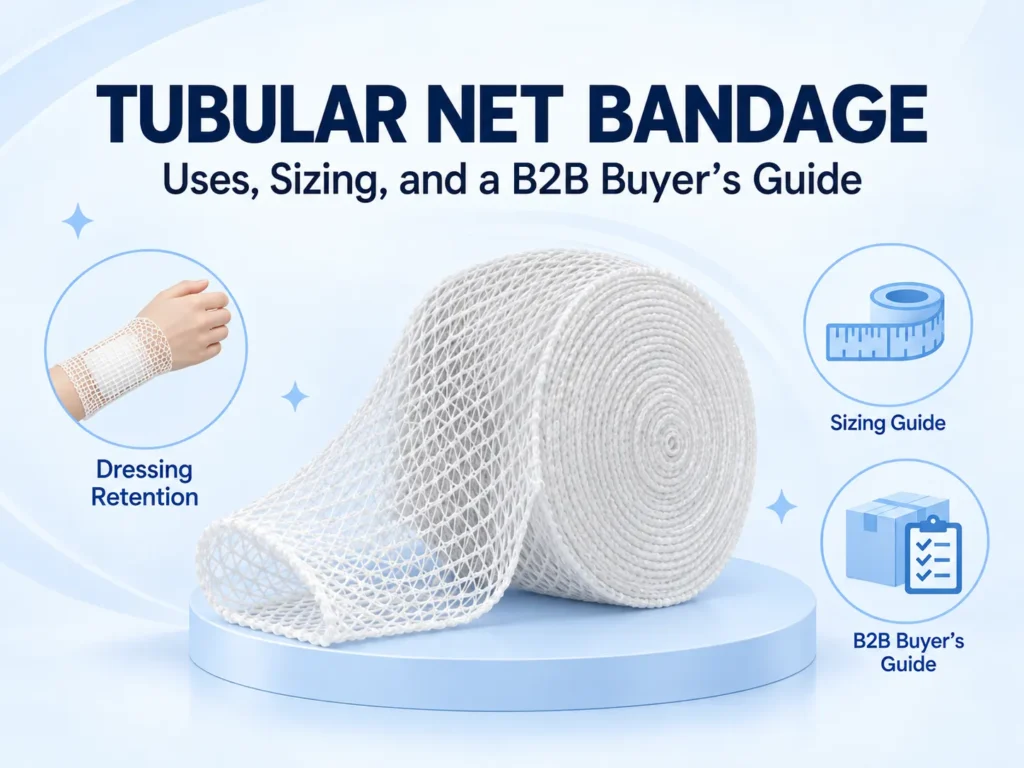
Instead, a tubular net bandage is a lightweight, stretchable, open-mesh layer designed to help hold a dressing in place.
In this guide, you will learn what tubular net bandage is, where it is commonly used, how sizing works, and what distributors, healthcare suppliers, and private-label buyers should confirm before placing a bulk order.
Quick Answer: A tubular net bandage is an open-mesh, stretchable medical textile used as a secondary layer to retain a primary dressing. Buyers should select it based on the body area, finished dressing bulk, mesh construction, stretch and recovery, size system, packaging format, and intended market requirements.
What Is a Tubular Net Bandage?
A tubular net bandage is a seamless, tube-shaped, open-mesh textile that stretches over a body area and the dressing beneath it.
Its role is straightforward: it helps keep a primary dressing in position.
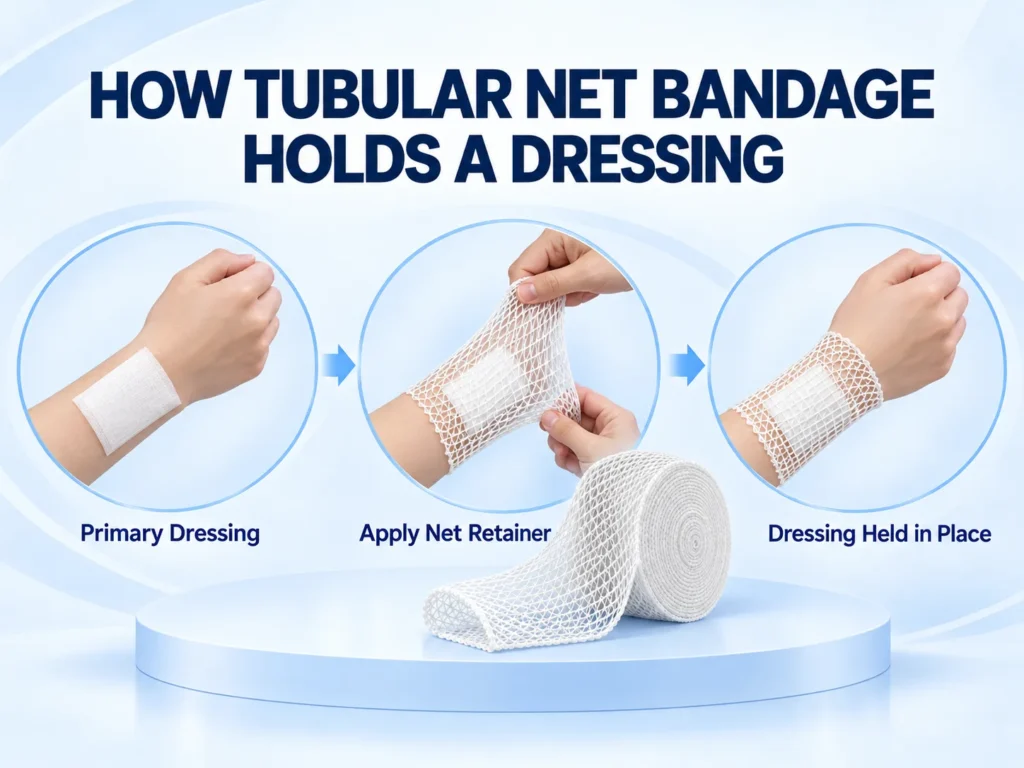
For example, a healthcare professional may apply a gauze pad, foam dressing, absorbent pad, or another appropriate primary dressing first. A tubular net bandage can then be placed over that dressing to help secure it without wrapping the area in dense fabric or applying adhesive tape around every edge.
Most tubular net bandages are supplied in one of several formats:
- Continuous rolls
- Dispensing boxes
- Pre-cut lengths
- Standard hospital packs
- Distributor or private-label packaging
The open-mesh construction is what separates this product from many conventional tubular bandages. Rather than fully covering the area with a dense knit, the net structure provides flexible retention while keeping the outer layer relatively lightweight.
Here is the important distinction:
A tubular net bandage is generally a dressing-retention product. It should not be assumed to provide compression, therapeutic support, wound treatment, or clinical protection unless the specific product is designed, tested, and labeled for that purpose.
If you need a broader overview of tubular textile products, see our Tubular Bandage Guide.
And if you are comparing the two product categories directly, read our Tubular Bandage vs. Tubular Net Bandage guide.
What Is Tubular Net Bandage Used For?
Tubular net bandage has one main job: helping hold a dressing in place.
But that simple function can be useful in several different care and supply situations.
Holding Primary Dressings in Place
This is the most common use.
After a primary dressing has been selected and applied, tubular net bandage can be placed over it as a secondary retention layer. It helps reduce the risk of the dressing shifting during normal movement.
This can be especially useful when a flat dressing needs to conform to a rounded, mobile, or difficult-to-wrap area.
The key point is simple:
Tubular net bandage helps retain a dressing. It does not replace the primary dressing itself.
Covering Difficult Body Contours
Some body areas are inconvenient to secure with adhesive tape or a traditional rolled bandage.
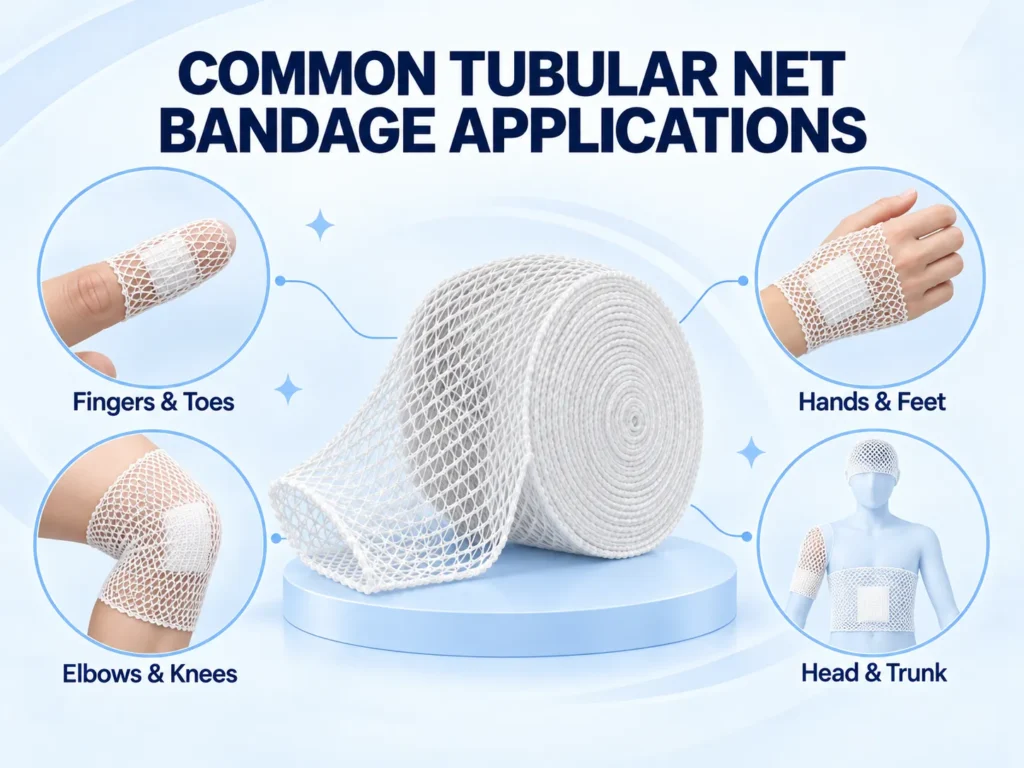
Think about:
- Fingers and toes
- Hands and feet
- Elbows and knees
- Shoulders
- The head
- Smaller limbs
- Larger limbs
- Parts of the trunk
These areas can move frequently, have uneven contours, or make tape placement difficult.
An elastic net structure can stretch over those contours more easily than a flat dressing-retention method. But suitability always depends on the specific dressing, body area, patient condition, product instructions, and applicable professional guidance.
Supporting Frequent Dressing-Change Workflows
In some care settings, dressings need to be checked, changed, or adjusted more often.
A tubular net retainer may simplify that workflow because it can be removed and repositioned without applying fresh adhesive tape each time.
That does not make it a treatment product. It is simply a practical fixation option for workflows where dressing access matters.
For healthcare providers and distributors, this can be a useful product-positioning point:
- Easy to remove for dressing inspection
- Easy to replace after a dressing change
- Less dependence on adhesive fixation
- Flexible for different body contours
- Available in multiple sizes and formats
When Tape Is Not Preferred
In some situations, adhesive tape may not be the preferred fixation method.
For example, a care team may evaluate alternative retention options when tape is inconvenient, when the body contour makes taping difficult, or when frequent dressing changes make repeated tape application impractical.
Still, avoid overpromising.
Do not describe a tubular net bandage as “safe for all skin types,” “non-irritating for everyone,” or “able to prevent skin damage.” Product suitability depends on the actual material, application, dressing type, patient condition, and professional judgment.
Tubular Net Bandage vs. Tubular Bandage
The names sound similar.
The products are not interchangeable.
A standard tubular bandage is usually made from a denser knitted or elasticated textile. Depending on its construction, it may be used for coverage, protection, dressing retention, or light support.
A tubular net bandage has a different focus. Its open-mesh structure is primarily designed for flexible dressing retention.
| Feature | Tubular Net Bandage | Tubular Bandage |
|---|---|---|
| Construction | Open-mesh, stretchable net structure | Denser knitted or elasticated tubular textile |
| Main role | Holding dressings in place | Coverage, protection, retention, or light support depending on design |
| Feel and coverage | Lightweight and open | More complete textile coverage |
| Airflow | More open by design | Depends on material and knit density |
| Compression | Should not be assumed | May be available in specific elasticated designs |
| Key sourcing focus | Mesh, stretch, recovery, fit, packaging | Material, density, width, stretch, intended function |
Here is the practical rule:
Choose tubular net bandage when the main requirement is flexible dressing retention. Choose a standard tubular bandage when the project requires denser coverage, a different textile structure, or a product with specifically defined support characteristics.
For a more detailed decision guide, see Tubular Bandage vs. Tubular Net Bandage: Key Differences, Uses, and Buyer Considerations.
How to Choose the Right Tubular Net Bandage Size
This is where many buyers make avoidable mistakes.
A product can look correct in a catalog and still be the wrong size in actual use.
Why?
Because a tubular net bandage does not only need to fit the body area. It also needs to fit over the finished dressing.
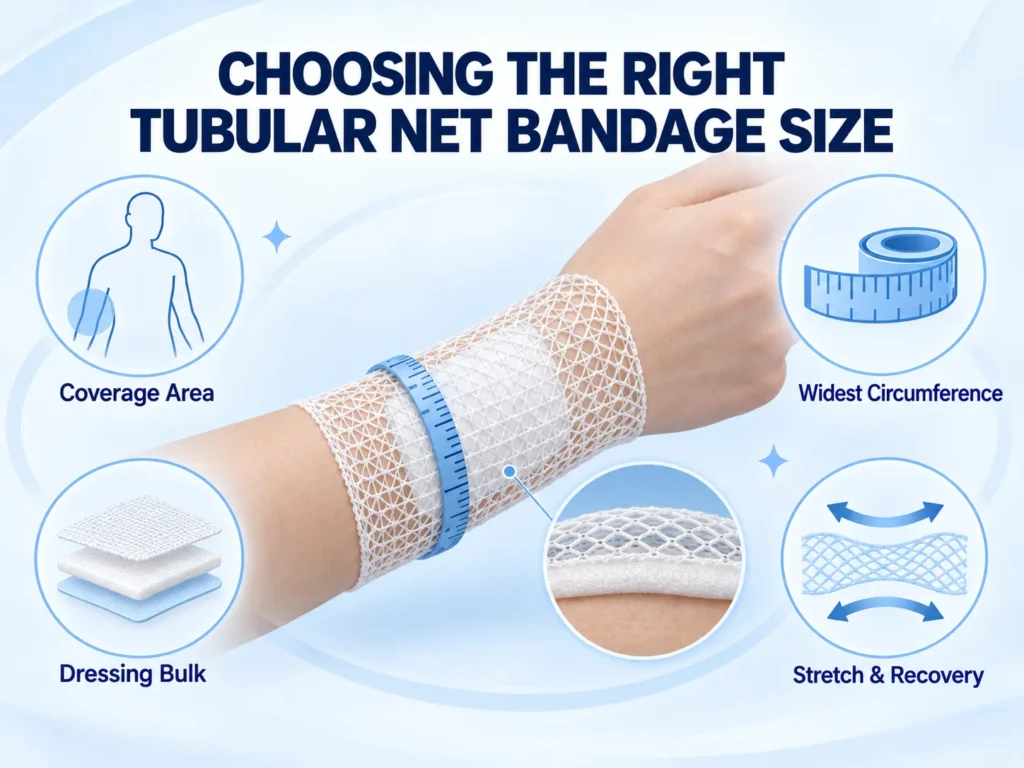
Start With the Coverage Area
Do not begin with the wound size.
Instead, begin with the body area the net needs to cover.
For example:
- Finger or toe
- Hand or foot
- Wrist or forearm
- Arm or lower leg
- Elbow or knee
- Shoulder or thigh
- Head
- Trunk
The relevant measurement is the area the net must stretch over, not just the dimensions of the dressing underneath.
Measure the Widest Relevant Circumference
Once you know the coverage area, identify the widest point that the tubular net bandage must pass over.
Then compare that measurement with the supplier’s own sizing chart.
This matters because sizing systems are not standardized across the market.
One supplier may use letters such as A, B, C, D, and E. Another may use numbers such as 1 through 11. A third may list only flat width, relaxed circumference, or recommended body area.
So a “Size C” from one supplier may not match a “Size C” from another.
Buyer tip: Never approve a tubular net bandage based only on a size label. Ask for the actual product size chart, measurement method, and recommended body-area range.
Factor in Dressing Bulk
This is one of the most overlooked parts of tubular net bandage selection.
A net bandage may fit comfortably over bare skin. But once a foam dressing, gauze padding, absorbent pad, or multi-layer dressing is in place, the same net may become too tight.
Or too loose.
That is why the right sizing question is not:
“What size fits this arm?”
It is:
“What size fits this arm with the expected finished dressing underneath?”
A well-designed sample evaluation should consider:
- The body area
- The widest relevant circumference
- The dressing thickness
- The expected movement of the area
- The product’s stretch and recovery characteristics
Check Recovery, Not Just Stretch
Stretch is only half the story.
A product must stretch enough to pass over the intended area. But it also needs reasonable recovery after stretching so it can continue to retain the dressing.
A net that stretches easily but does not recover well may feel acceptable during initial application and then become loose later.
When evaluating a sample, buyers should ask:
- Does the net pass over the intended body area smoothly?
- Does it sit evenly over the dressing?
- Does it twist or bunch?
- Does it become too loose after stretching?
- Does it create unnecessary tightness?
- Does it maintain the expected retention performance?
Product photos alone cannot answer these questions. Sample testing matters.
How to Apply Tubular Net Bandage Over a Dressing
This section is a general product-use overview, not a clinical procedure.
Actual use should follow the specific product instructions, local protocols, and qualified healthcare guidance where applicable.
- Confirm that the primary dressing has already been selected and applied according to the appropriate care plan or product instructions.
- Choose the tubular net bandage size based on the coverage area and the finished dressing bulk.
- Prepare the required length according to the product instructions.
- Gently position the net over the dressing without excessive stretching, twisting, rolling, or bunching.
- Check that the dressing remains in position and that the net is not unnecessarily restrictive. Important: Tubular net bandage is designed for dressing retention. It should not be used or marketed as a substitute for a primary dressing, a prescribed compression system, or a medical support device unless the specific product is designed and labeled for that purpose.
What B2B Buyers Should Specify Before Ordering
“T ubular net bandage” is a product category.
It is not a complete product specification.
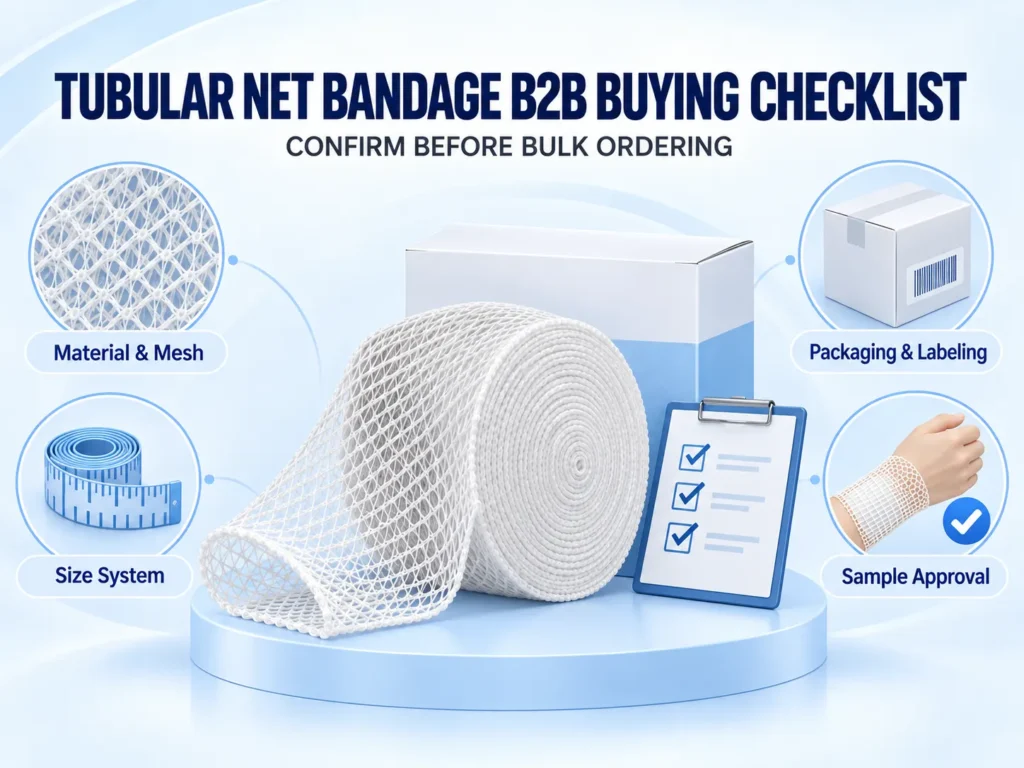
For hospital supply projects, distributor programs, tenders, or private-label orders, buyers need more than a product name and a target price.
They need an agreed specification.
| Specification area | What buyers should confirm |
|---|---|
| Intended use | Is the product intended for dressing retention only, or is another function expected? |
| Material composition | What fibers are used? Is a latex-free declaration required? |
| Mesh construction | What level of openness, mesh consistency, and softness is required? |
| Stretch and recovery | How much stretch is needed, and what recovery performance is expected? |
| Size system | Is sizing based on flat width, circumference, stretch range, or recommended body area? |
| Dressing bulk | What type and thickness of dressing must the product fit over? |
| Product format | Continuous roll, dispensing box, pre-cut length, or individual pack? |
| Packaging | Roll length, unit count, carton quantity, moisture protection, and storage requirements |
| Labeling | Brand name, artwork, barcode, lot number, language, and destination-market information |
| Private label | Custom logo, packaging design, SKU structure, and approved artwork process |
| Documentation | Product specification sheet, material declarations, traceability records, and quality documents |
| Sample approval | Will bulk production follow a signed specification and approved sample? |
For B2B sourcing, this is the real difference between a smooth order and an avoidable problem.
A buyer may ask for “elastic net bandage, Size C, 25 m roll.”
But that request is still incomplete if it does not define:
- What “Size C” means
- What material is required
- What mesh structure is expected
- Whether the product needs to fit over a thick dressing
- How the roll should be packaged
- What label information is required
- Which destination market the product will serve
A Practical Sample-Approval Checklist
Before confirming a bulk tubular net bandage order, test an approved sample against the real project requirements.
Use this checklist:
- Confirm the size over the intended body area with a representative finished dressing in place.
- Check whether the mesh looks consistent before and after stretching.
- Test whether the net can be applied without excessive twisting or bunching.
- Check whether the fit feels too loose, too tight, or appropriate for the intended retention role.
- Confirm the cut edge performs as expected for the project.
- Verify the roll length, packaging format, and unit quantity.
- Check label content, barcode placement, batch information, and carton markings.
- Confirm private-label artwork and destination-market language requirements.
- Lock the approved sample and technical specification as the reference standard for production and reorders.
This extra step matters.
A size label and a product photo are not enough to guarantee that the finished product will work correctly in a real distribution or healthcare supply workflow.
Common Sourcing Mistakes to Avoid
Here are five mistakes that come up often.
Treating Tubular Net Bandage and Tubular Bandage as the Same Product
They may both be tubular. They do not necessarily have the same structure, purpose, or sourcing requirements.
Selecting Size Based Only on the Wound
The net needs to pass over the body area and the completed dressing. Wound dimensions alone are not enough.
Assuming Size Labels Match Across Suppliers
A, B, C, 1, 2, 3, Small, Medium, and Large are not universal standards.
Always request the supplier’s actual size chart.
Comparing Price Before Comparing Specifications
A lower price may reflect a different material blend, mesh construction, roll length, size range, packaging format, or quality-control standard.
Compare like for like.
Using Unsupported Medical Claims
Do not market a dressing-retention net as a wound-healing, compression, infection-prevention, or therapeutic-support product unless the specific product has been developed, tested, and labeled for those claims.
Tubular Net Bandage FAQ
What is a tubular net bandage used for?
A tubular net bandage is used to help retain an already-applied primary dressing. Its open-mesh structure can provide flexible fixation without relying on adhesive tape around the entire dressing area.
Is tubular net bandage the same as tubular bandage?
No. Tubular net bandage is generally an open-mesh dressing-retention product. Tubular bandage is usually denser and may serve coverage, protection, retention, or light-support functions depending on the product design.
How do I choose the right tubular net bandage size?
Start with the body area to be covered, measure the widest relevant circumference, consider the thickness of the finished dressing, and confirm the final choice using the supplier’s own size chart and an approved sample.
Does tubular net bandage provide compression?
Not by default. Its main role is dressing retention. Any compression or support characteristic depends on the specific product’s design, testing, labeling, and intended use.
Can tubular net bandage be supplied for private-label programs?
Depending on the supplier’s manufacturing capabilities, tubular net bandage may be available for private-label programs. Buyers should confirm the material, size range, packaging, label artwork, barcode requirements, destination market, and order quantity before requesting a quotation.
Source Tubular Net Bandage for Your Supply Program
Looking for tubular net bandage for a hospital supply chain, medical distributor, pharmacy brand, or private-label program?
Share your intended application, preferred material, target size range, packaging format, label requirements, and destination market with the Haody Medical team.
A clear specification at the beginning helps ensure that the final product fits your sourcing needs, packaging workflow, and end-user application.
This article provides general product information for sourcing and reference purposes only. It is not medical advice. Product selection and clinical use should follow the relevant product instructions, applicable regulations, and guidance from qualified healthcare professionals.