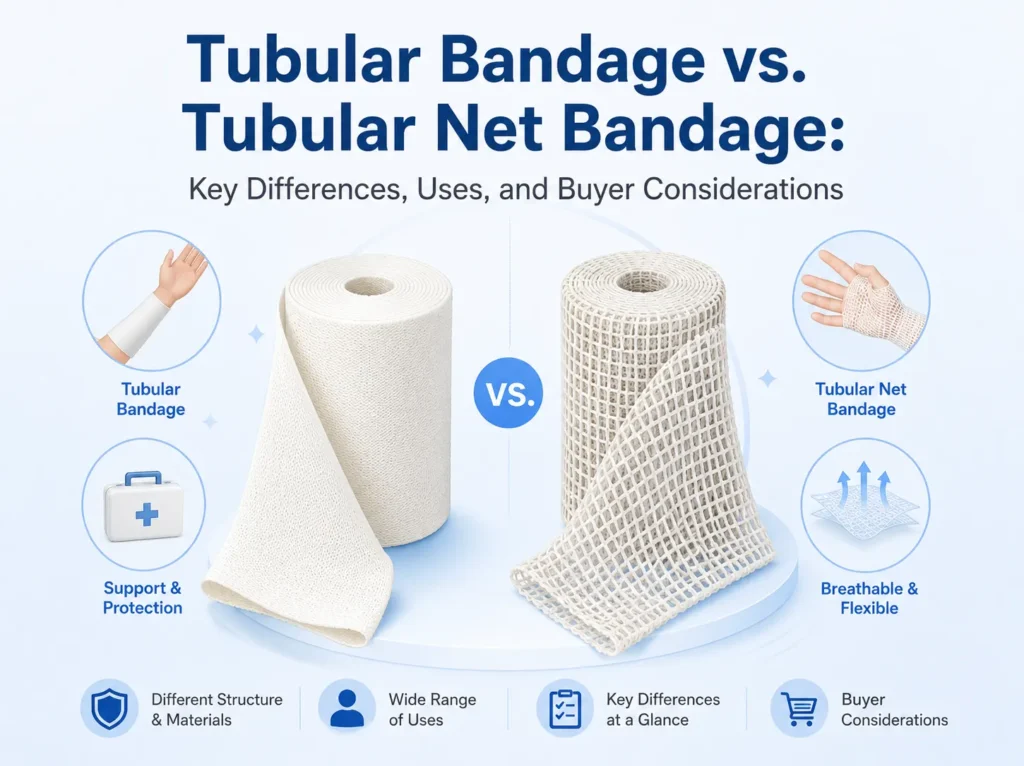
Tubular bandage and tubular net bandage are related products, but they are not interchangeable. A tubular bandage is usually a denser or elasticated tube-shaped textile used for coverage, retention, or light support, while a tubular net bandage is an open-mesh elastic retainer mainly used to hold dressings in place.
That’s the short version.
If you are comparing these two products, you are probably trying to solve one of two problems: how to keep a dressing in place, or how to choose the right structure for a specific body area. This guide breaks down the differences, the best use cases, and the buyer considerations that matter before you place an order.
What Is a Tubular Bandage?
A tubular bandage is a seamless, tube-shaped medical textile that can be selected for coverage, protective layering, dressing retention, or light support, depending on its material and construction.
However, “tubular bandage” is a broad category, not one fixed product type. Some options use a denser knit for more complete coverage, while elasticated versions may provide a closer fit. For a detailed guide to tubular bandage uses, sizing, and application, see our [What Is a Tubular Bandage? Uses, Sizing, and Application Guide].
In this article, the key question is simpler: when is a standard tubular bandage the better choice, and when does a tubular net bandage make more sense?
What Is a Tubular Net Bandage?
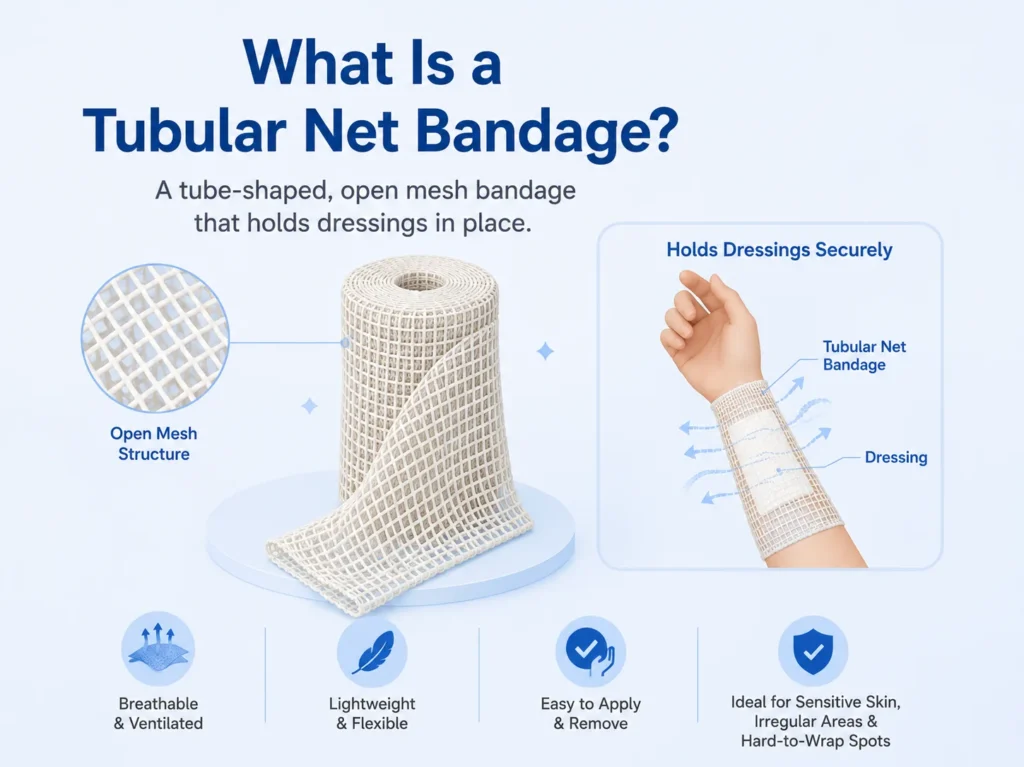
A tubular net bandage is a tube-shaped bandage with an open mesh structure.
Its main job is to help hold dressings in place. The net construction makes it more breathable and flexible, which is useful when the body area is hard to wrap or when adhesive tape is not the best option.
This is where it differs most from a standard tubular bandage.
A tubular net bandage usually focuses on retention and ventilation, not compression or support. In many cases, that makes it a better fit for dressing fixation on sensitive skin, irregular body areas, or spots that move a lot.
The structure matters here. The open mesh can make the product feel lighter and easier to apply, while still keeping the dressing where it needs to be.
Tubular Bandage vs. Tubular Net Bandage
Here’s the simplest way to think about it:
| Comparison Point | Tubular Bandage | Tubular Net Bandage |
|---|---|---|
| Structure | Denser or elastic tube-shaped knit | Open mesh or net structure |
| Main function | Coverage, protection, retention, or light support depending on design | Dressing retention and flexible fixation |
| Coverage level | More complete coverage | More open coverage |
| Breathability | Depends on material and knit density | Usually higher because of the mesh design |
| Support potential | Some designs may offer light support | Usually not positioned as a support product |
| Best for | Limbs, joints, fingers, toes, areas needing coverage | Hard-to-bandage areas, sensitive skin, dressing retention |
| Buyer focus | Material, width, stretch, recovery, size range | Mesh structure, elasticity, retention performance, applicator compatibility |
The key point is simple: one is not better than the other. They solve different problems.
If you need fuller coverage or a more traditional textile feel, tubular bandage is usually the better starting point. If you need breathable dressing retention and easy fixation, tubular net bandage is often the better fit.
When to Choose a Tubular Bandage
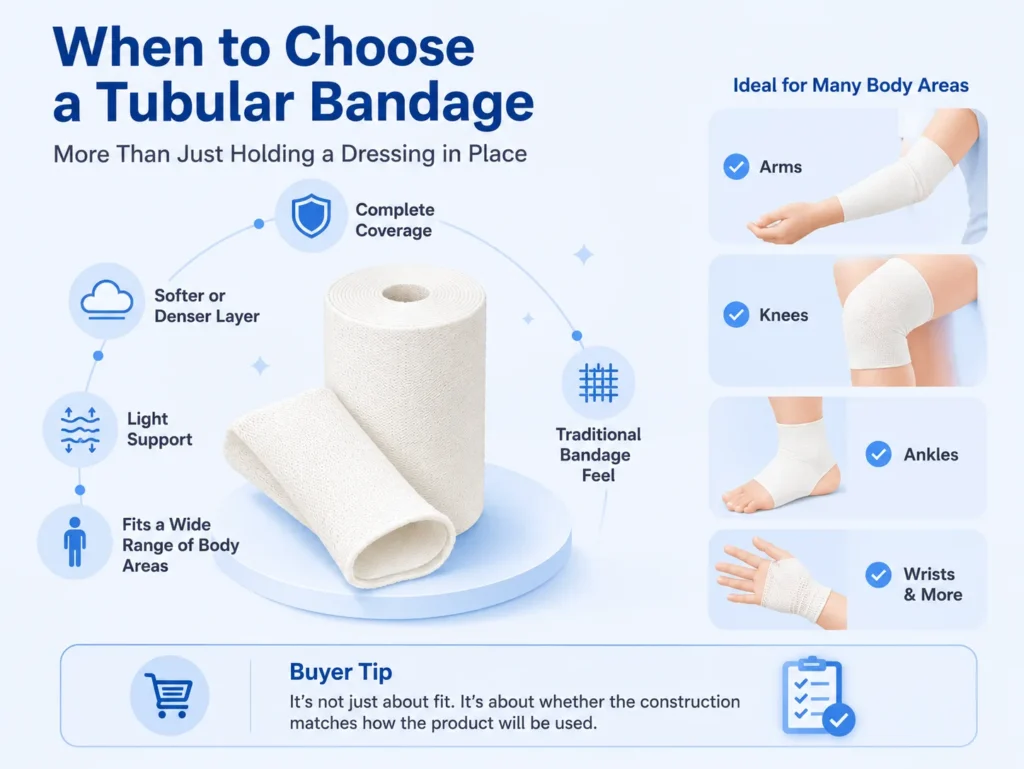
Choose a tubular bandage when the job is more than just holding a dressing in place.
It is a good option when you want:
- More complete coverage.
- A softer or denser textile layer.
- Light support from an elasticated design.
- A product that can fit a broader range of body areas.
- A more traditional bandage feel for a medical textile application.
This is also why tubular bandages are often used on limbs, joints, and smaller body parts where a close, stable fit matters.
For buyers, the real question is not just “Does it fit?” It is “Does the construction match the way the product will be used?”
When to Choose a Tubular Net Bandage
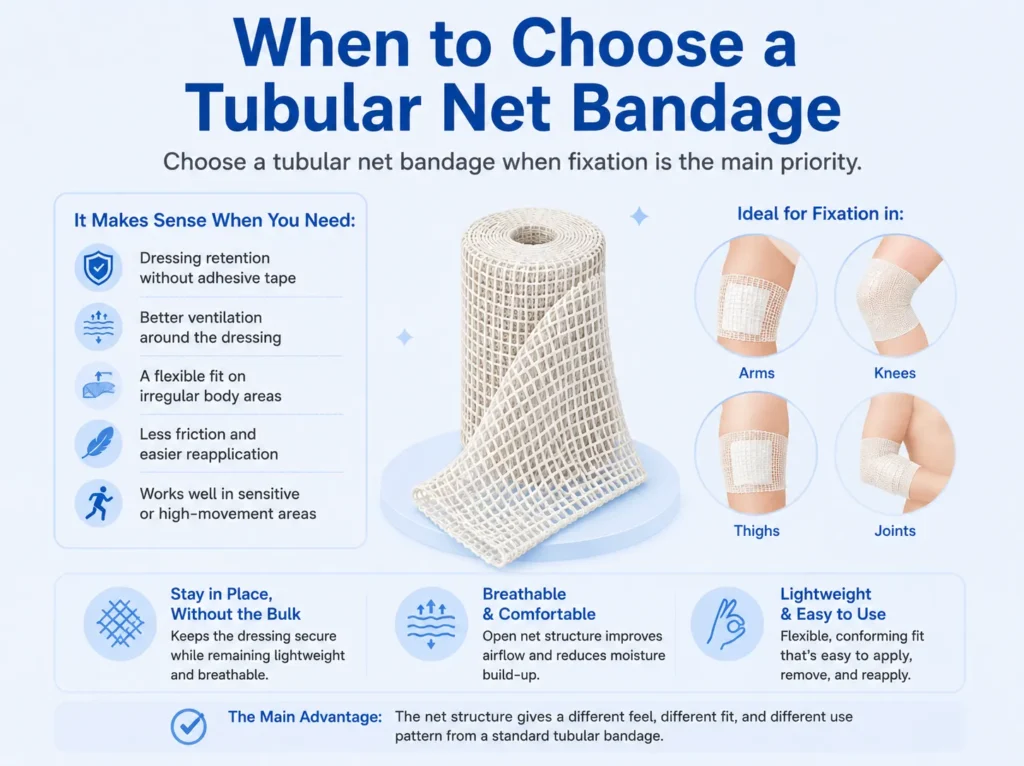
Choose a tubular net bandage when fixation is the main priority.
It makes sense when you need:
- Dressing retention without adhesive tape.
- Better ventilation around the dressing.
- A flexible fit on irregular body areas.
- Less friction and easier reapplication.
- A product that works well in sensitive or high-movement areas.
This type is especially useful when the dressing needs to stay in place, but you do not want the extra bulk of a denser bandage.
That’s the main advantage.
The net structure gives the product a different feel, different fit, and different use pattern from a standard tubular bandage.
Dressing Type Changes the Choice
This is one of the most overlooked parts of the decision.
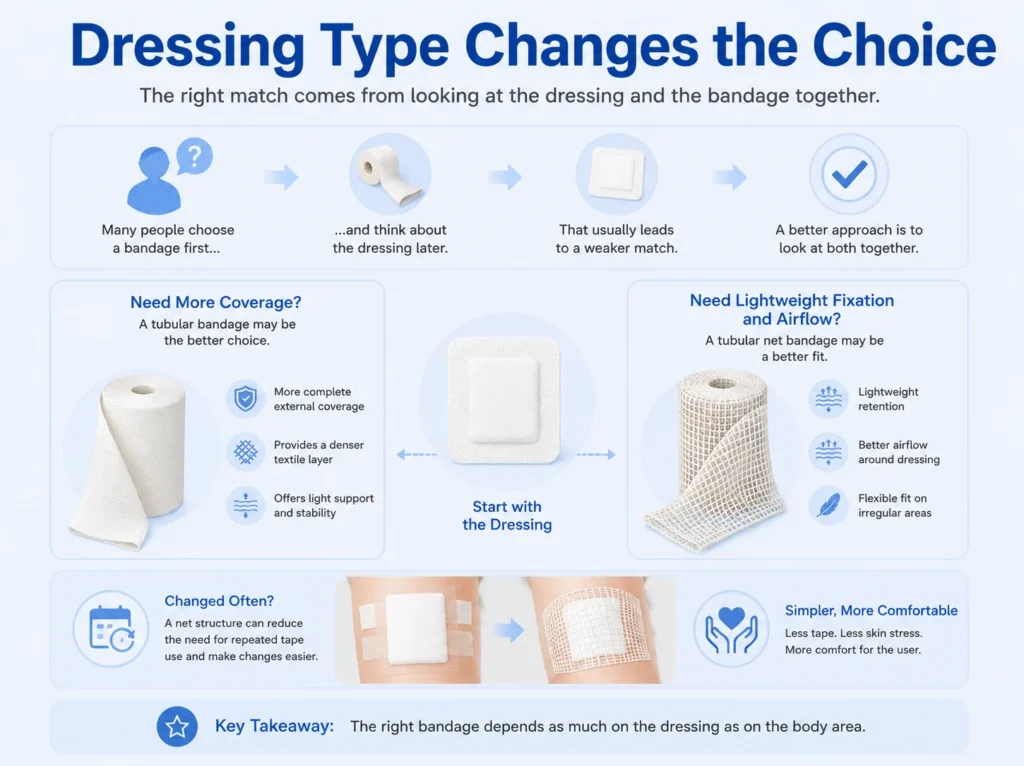
Many people choose a bandage first and think about the dressing later. That usually leads to a weaker match.
A better approach is to look at the dressing and the bandage together.
If the dressing needs more complete external coverage, a tubular bandage may make more sense. If the dressing needs a lightweight retainer and you want more airflow, a tubular net bandage may be a better fit.
That matters even more if the dressing will be changed often. In that case, a net structure can reduce the need for repeated tape use and may make the process simpler.
In other words, the right choice often depends as much on the dressing as on the body area.
What Buyers Should Confirm Before Ordering
For bulk sourcing, the product name alone is not enough.
A clear specification should define the function, material, size range, packaging, and sample approval requirements before production begins.
For Tubular Bandages
Buyers should confirm:
- Fiber composition.
- Flat width and size range.
- Stretch and recovery.
- Knit density.
- Roll length or pre-cut length.
- Color and size coding.
- Packaging format.
For Tubular Net Bandages
Buyers should confirm:
- Mesh opening and density.
- Elasticity and recovery.
- Retention performance.
- Size range by body area.
- Applicator compatibility.
- Latex-free or other market-specific requirements.
- Packaging and labeling.
If you are sourcing for hospitals, pharmacies, retail channels, or private-label programs, the details matter. A product that works in one channel may not be right for another.
Sample Approval and Batch Consistency
This step is easy to skip, and that is usually a mistake.
Before bulk production, a sample should be checked for material feel, sizing, stretch, construction, packaging, and labeling. For a tubular net bandage, the mesh uniformity and the way the product behaves under stretch matter as well.
That sample approval step helps reduce surprises later.
It also helps you lock in the exact version you want before the order scales up. For B2B buyers, that can save time, reduce complaints, and avoid rework.
A simple written spec sheet is often enough to make the approval process much cleaner.
Common Fit Problems
When a tubular bandage or tubular net bandage does not work well, the problem is usually fit, construction, or application method.
| Common issue | Likely cause | What to check |
|---|---|---|
| Edge rolling | Size, cut length, or stretch is unsuitable | Recheck circumference, length, and application method |
| Wrinkles or bunching | The material was not smoothed during application | Reapply with the fabric lying flat |
| Slipping | The construction does not match the retention need | Review elasticity, texture, and product type |
| Excessive tightness | The size is too small or overstretched | Stop use and follow the product instructions |
The product should feel secure, not restrictive.
If it does not sit smoothly, the issue is often not the user — it is the product choice.
Related Products
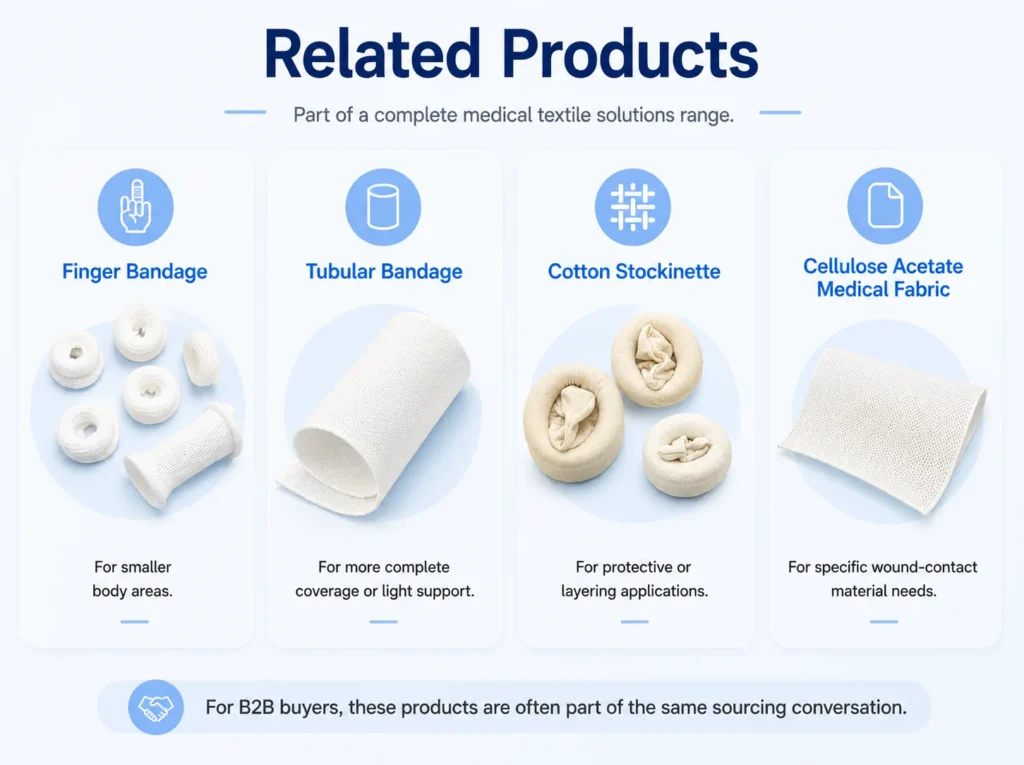
Tubular bandages and tubular net bandages usually sit inside a broader medical textile range.
Related products may include:
- Finger Bandage for smaller body areas.
- Tubular Bandage for more complete coverage or light support.
- Cotton Stockinette for protective or layering applications.
- Cellulose Acetate Medical Fabric for specific wound-contact material needs.
For B2B buyers, these products are often part of the same sourcing conversation.
Frequently Asked Questions
Is tubular net bandage the same as tubular bandage?
No. They are related, but not interchangeable. A tubular bandage is generally denser or more versatile in function, while a tubular net bandage is mainly used for flexible dressing retention and ventilation.
Which one is better for dressing retention?
It depends on the body area, dressing type, and coverage need. Tubular net bandage is often preferred where an open mesh structure and flexible fixation are more useful.
What should buyers confirm before ordering?
Buyers should confirm the intended function, size range, material structure, packaging, labeling, and sample approval requirements.
Final Thoughts
Tubular bandage and tubular net bandage both have a place in medical textile sourcing. The right choice depends on the required function, body area, dressing type, material construction, and packaging format. For B2B buyers, the most reliable approach is to define the intended use first, confirm the technical specification, and approve a sample before bulk production.
Suzhou Haody Medical Products Co., Ltd. is an ISO 13485-certified medical textile manufacturer established in 2008. We supply tubular bandages, tubular net bandages, finger bandages, stockinette, and other medical textile products for distributors, healthcare suppliers, and private-label programs. Looking for custom materials, size ranges, roll lengths, or private-label packaging?
Contact Haody Medical to discuss your specifications, sample requirements, and bulk-order needs.
Written by: SEO Specialist at Suzhou Haody Medical Products Co., Ltd.
Product accuracy reviewed by: Haody Medical Product Team
Disclaimer: This article provides general product and educational information only. It is not medical advice and does not replace guidance from a qualified healthcare professional. Product selection and use should follow the manufacturer’s instructions, applicable regulations, and professional guidance where needed.